
Noise is often inevitable in hydraulic systems, but discovering its sources can help you to better design your systems to alleviate some of it.
Monday morning traffic, lineups at the Krispy Kreme drive-through, and teenagers; all crap we just put up with every day with nary more than a shrug. I’m officially adding noisy hydraulics to this list, because we fluid power professionals and machine designers have given up on making them quiet, just as we have long-ago abandoned hope of our teens cleaning their rooms.
But why? Why should we simply accept that hydraulic power units should sound like a Tie Fighter flyby looped on 78-speed (that one’s for the Gen Xers)? The low-order harmonics produced by gear and piston pump ripple will sometimes find conduit tubes and pipes, or even structural bars and plates, that adore the resonant frequency and want to sing along.

Hydraulic power units can often be noisy, and depending on their harmonics, can be gratingly irritating to anyone near their use.
Mid-and high-order harmonics, however, are the whiny and screechy tinny sounds emitted from many power units that make your blood curdle when it hits a particular note. Harmonics are the multiples of the fundamental note that occur because hydraulic pumps create discrete pressure wave events rather than a continuous and pure sine wave tone. A pump with a 100 Hz fundamental is just an expression of its rate of repeating those pressure wave events, and any waveform that is not a pure sine wave (such as from a single voice synthesizer keyboard) contains harmonics.
Every multiple of the fundamental frequency is called its Order, so 200 Hz is the 2nd Order harmonic, 400 Hz is the 4th order harmonic, and 2000 Hz is the 20th Order harmonic (Figure 1). The fundamental frequency and its amplitude (loudness) are generally a product of the pump itself, although anything in or on the power unit with a matching resonant frequency can increase the amplitude of that note. The same is true for the harmonics — a single piece of tube might have a resonant frequency matching one of the pump harmonic frequencies, which increases the amplitude of that harmonic. It’s very much like the singing wine glasses, where circular rubbing of the glass’s rim creates a specific note reflecting the mechanical shape of the glass, its mass, and the amount of water contained within it.
Human ears are sensitive to the 2-5 kHz range, so when harmonics scream in your ear around this range, we find it particularly hair-raising. The complexity of noise possible with hydraulic power units is nearly impossible to predict — the pump, reservoir, plumbing, cutouts, brackets, coolers, and valves/manifolds all contribute their own unique auditory signatures to create a recipe for each power unit. Each component may also be part of a cascading resonance and resulting harmonic nightmare, further adding to the pain.
Sometimes we get lucky, and the pump’s fundamental frequency is entirely dissonant from every component’s resonant frequency, and very little is amplified enough to offensive levels. But surely there is a way to leave out the guesswork? I’m going to present to you two methods, one of which offers a ballpark-only system of measuring resonant frequency, while the other offers a precise method of measuring.

Figure 1. Every multiple of the fundamental frequency is called its Order, so 200 Hz is the 2nd Order harmonic, 400 Hz is the 4th order harmonic, and 2000 Hz is the 20th Order harmonic, as demonstrated here.
Ballpark measurements are fine
The first is using a simple tone generator on your phone, which you can probably download for free. Then find a very loud, um, loudspeaker, which you can rent from a music store — something with a self-powered 15 in. woofer and capability of 125 dB or louder. Some new models may already have Bluetooth capability, but if not, you’ll need a receiver or mixer that can send a signal to the loudspeaker.
Once you have your rig, place the speaker as close as possible to the various major components — reservoir, pump/motor group, cooler, filter assembly, and tubes (if they’re already made) — one at a time, of course. Now, starting at 20 Hz on your tone generator, very slowly sweep upwards while keeping one gentle hand on the component. When you feel the component vibrate intensely, you’re close to discovering its resonant frequency. Sweep up and down to pinpoint its most aggressive vibration frequency, write it down, and then move on to the next component or assembly (Figure 2). Remember that large items, such as a reservoir or a high-volume air/oil cooler, can have multiple modes/frequencies.
Getting more precise
If you’d like to get more precise with your measurements, you can purchase a shaker-style vibrator used for non-destructive testing. You’re not trying to break anything, so you’ll only need a small one, which will be better suited for higher frequency operation, anyway. These units will come with a control unit to set the vibration frequency, and you can set the unit directly on large objects, or small objects can be mounted on the shaker itself.
You will then obtain a vibration analysis system commonly used by maintenance departments to provide early detection of bearing and pump failures. Their sensors can be mounted directly to the component being measured, taking the guesswork out of the “calibrated hand” method. Then, just as before, sweep from around 20-10,000 Hz and observe the resulting chart for the peak amplitude and the frequency.
If you have multiple items with similar resonant frequencies or harmonics of those frequencies, you may need to pay attention to them later. I’ve created an example chart that shows imaginary fundamental and harmonic frequencies of a reservoir, cooler, filter, and a piece of 3-foot ¾ in. ID tube. Around 400-425 Hz, the reservoir, cooler, and filter share somewhat close harmonics, but they probably don’t compound much to worry about. However, you can see that around 315-328 Hz, the reservoir’s 13th harmonic aligns fairly closely to the 3rd and 4th harmonics of the cooler and filter, respectively.
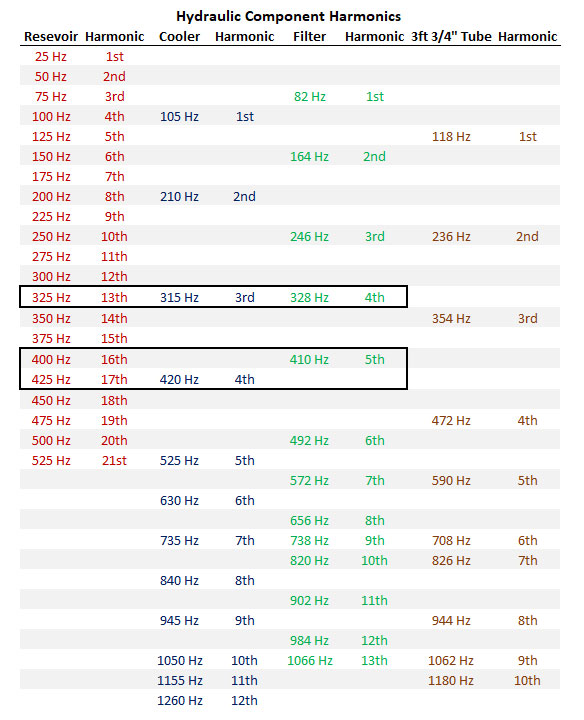
Figure 2. Example chart shows imaginary fundamental and harmonic frequencies of a reservoir, cooler, filter, and a piece of 3-foot ¾ in. ID tube.
These neighboring harmonics may or may not cause problems, and you won’t know until you finish assembling the power unit and testing it. If the pump’s fundamental frequency is anywhere around 315-328 Hz, it’s likely that your power unit is going to sound like hot garbage. But don’t fret just yet – once the power unit is assembled and filled with oil, the frequencies and amplitude will change. You’ll see attenuation (getting quieter) and a lowering of fundamental (resonant) frequencies as the increased mass from the oil interacts with all the components, especially the reservoir.
Your original test isn’t garbage, but feel free to test again after assembly to see how much everything has changed. It’s possible the predicted issues with the reservoir, cooler, and filter may still exist, but at a lower frequency. To correct these issues, use the same benefit that hydraulic oil provides you — change the mass of the component. You can mount heavy magnets to steel parts, change the length/diameter of tubes and pipes, switch to longer baskets on filters, or any other option to change the size and mass of an item.
Is all this too much to worry about? Nine times out of ten, yes. However, some customers have stipulations about maximum sound pressure level, which, even when shown to be within specification using a calibrated meter, may prevent final sign-off due to harsh harmonics. Or, at one meter up and one meter out, the dB reading could vary widely depending on which of the 360º around the power unit you measured it from. Using this system helps you avoid assembling an orchestra of raucous Tie Fighters in the first place, saving you time and money on every subsequent build.
And if this editorial piece is a bit niche and has you wondering, “Why the hell is Josh writing about this?” it’s because I’m a DJ/Producer, believe it or not. Understanding these sound engineering concepts is part of the music production process. I kind of keep my electronic music hobby separate from my fluid power career because not many in our industry care much about raves, clubs, and house music. If you do, check me out on all the platforms — my DJ name is Crozford.
Filed Under: Components, Engineering Basics, Pumps & Motors
