
Contributed by Inderjeet Singh • Global Product Line Director, Trelleborg Sealing Solutions
From managing contamination caused by dirt and mud to helping precisely move heavy loads at construction sites, seals used in hydraulic motors, gearboxes and pumps for rotary fluid power applications face significant demands. Performance expectations for these high-pressure radial shaft seals are becoming more challenging as hydraulic component manufacturers need solutions that work at high speeds and pressures while meeting global performance standards. To meet these challenges, seal suppliers are investing in advanced test rigs with wider capabilities for operating parameters such as temperature, speed, torque, pressure, pressure spikes, and side loads. This extensive testing and validation process proves seals meet and exceed customers’ expectations in the field with less maintenance leading to less downtime and therefore lower cost of ownership for original equipment manufacturers, as well as improved efficiency.

The HPROS advanced test rig used by Trelleborg offers more capabilities for testing seal operating parameters such as temperature, speed, torque, pressure, pressure spikes, and side loads.
Hydraulic component manufacturers benefit from having a sealing supplier that provides parts compliant with industry standards and global requirements like the Regulation, Evaluation, Authorization and Restriction of Chemicals (reach) and the Restriction of Hazardous Substances (rohs). Sealing portfolios should also include products that are per- and polyfluoroalkyl free (pfas-free). For example, Trelleborg Sealing Solutions continues to evaluate its product and material portfolio to see what performance criteria can be achieved with alternative materials.
Supplier partners that can closely simulate a user’s application using in-house test rigs offer the most value when it comes to testing high-pressure radial shaft seals. The product development cycle for these seals should include three steps:
- Product engineering: Internal product design, finite element analysis (fea) and simulations.
- Process engineering: Tooling design and prototype development using state-of-the-art process development centers.
- Testing and validation: Pre-validation of the seal’s functionality and durability of samples according to customer requirements and application needs.
The most capable seal suppliers use test rigs for high pressure and pressure spikes. Advanced testing equipment should simulate real-world product conditions, ensuring component reliability and performance. For example, Trelleborg’s high-pressure test rig can replicate the working conditions of up to four seals simultaneously. It circulates oil within the test rig oil chamber at a variable flow rate at speeds of up to 34.9 ft/sec (10.6 m/sec) and pressures up to 2,900 psi/20 MPa. This includes real-time monitoring of absorbed torque and independent readings of both the temperature of the seal and the oil over thousands of hours, giving an accurate picture of the performance while the seal is in operation.
Additionally, Trelleborg’s pressure spike test rig simulates hydraulic motor conditions at speeds up to 6,000 rpm and medium pressures. Its key feature is a very high oil flow rate of 7.9 gpm (30 lpm), combined with the ability to generate pressure spikes within one second while recording data in real time. The rig also includes a built-in camera that precisely monitors when oil reaches the seal, ensuring that the timing of the readings is accurate.
Hydraulic component manufacturers should also have the option to fine-tune testing cycles and begin pre-validation on-site at their supplier’s location, helping streamline the process before moving to the production phase. Properly optimizing pressure and speed to maximize performance must be balanced with other factors like pressure pulsations and shaft misalignment which are frequent causes of seal failure.
When a hydraulic motor customer needed a solution to improve shaft to bore alignment in a high-pressure application, they asked Trelleborg to create a custom Stefa high-pressure radial shaft seal. Trelleborg experts used proprietary compounds to create prototypes of a seal with an energized lip and geometry that allowed for higher shaft movements and extrusion prevention, significantly extending the time between replacements. The optimized internal strain under pressure also reduces shaft friction, leading to lower energy consumption. Trelleborg tested it simultaneously at two different locations running pressure and velocity (pxv) and side load tests.
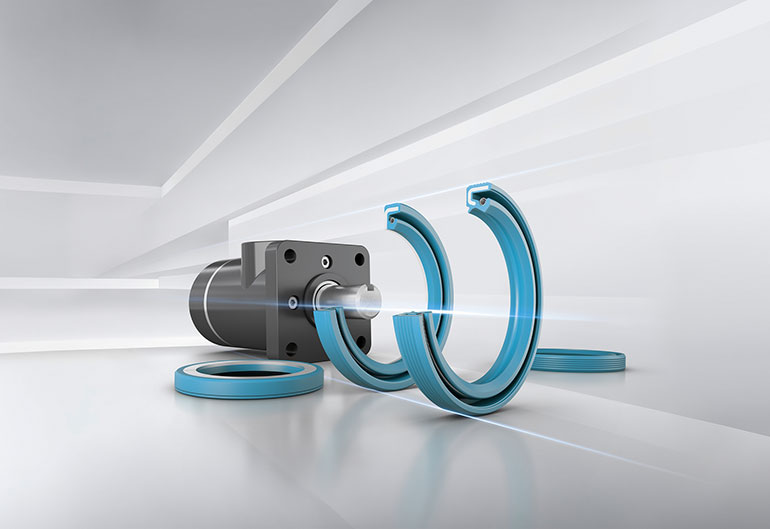
High-Stefa high-pressure radial shaft seals from Trelleborg.
Stefa can be easily customized and developed for the application to extend product life and maximize performance. It protects sensitive components over a long service life by effectively retaining lubrication. Because it is optimized for various speed and pressure combinations, it helps to improve sealing performance and also meets specific requirements for wear, temperature and oil compatibility. Finally, Stefa compensates for shaft misalignment and eccentricity with innovative engineered design.
After positive completion of all the tests, the custom Stefa seal was validated, and the user was able to begin mass production at their plants in China and the USA. Now they are working with Trelleborg to create new sizes for additional applications.
Equipment downtime can be one of the costliest issues for a construction, mining or agricultural operation. Improving reliability of seals is a simple and effective way of increasing equipment uptime. While breakdowns cannot be completely prevented, they can be minimized and predicted more accurately. That’s why hydraulic component manufacturers should make sure their seal supplier is leveraging advanced global in-house research and development capabilities to optimize geometries and materials, improving performance and durability across a wide range of applications with differing requirements.
Trelleborg Sealing Solutions
trelleborg.com/seals
What are the different levels of maintenance?
High-performing and durable seals can cut down on the amount of routine maintenance needed on equipment but many different maintenance considerations go into operating machinery in demanding environments.
- Routine maintenance:
Regular service and inspections at scheduled intervals like oil changes, filter replacements and lubrication. - Preventive maintenance:
Proactively replacing old or worn-out parts before they fail.
- Predictive maintenance:
Utilizing data and monitoring systems to forecast potential equipment failures, enabling maintenance or repairs to be carried out before unexpected breakdowns.
- Corrective maintenance: Replacing damaged or faulty components. This type of maintenance is unplanned but necessary.
- Emergency repairs: Urgent repairs to resolve critical problems that may pose safety risks or cause substantial downtime if not handled quickly.
- Routine cleaning: Keeping
equipment clean to help avoid the buildup of dirt and debris, which may lead to wear and damage to moving components.
Filed Under: Components, Engineering Basics, Sealing, Seals
