
By Jermaine Perry • Sales Manager, Daughtridge Sales, an MCE Automation company
Walk through almost any manufacturing plant — food and beverage, pharmaceutical, biotech — and you’ll see pressure gauges everywhere. They’re mounted on tanks, filtration systems, and process lines.
Their familiarity makes them dangerous.
Pressure gauges are sometimes treated as commodity items, something to replace quickly when they fail, ideally with whatever looks “close enough.” But in sanitary processes, the wrong gauge can contaminate product, shut down production, trigger regulatory scrutiny, or cause losses that dwarf the cost of the instrument itself.
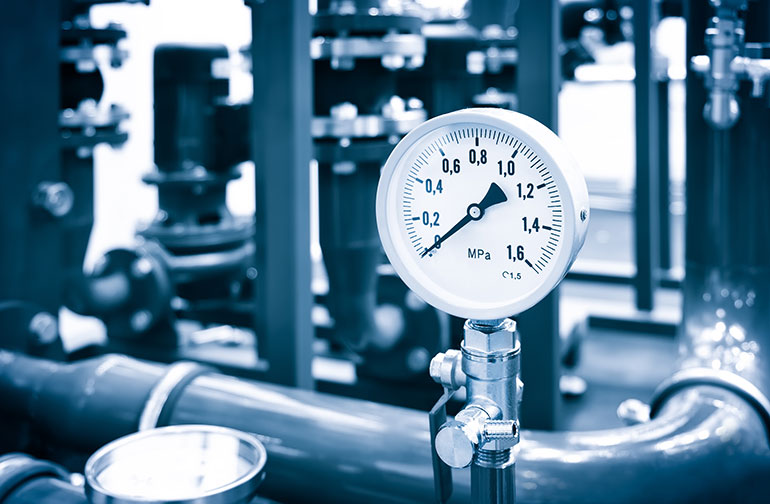
When a gauge fails, the priority is restoring operation, not always evaluating whether the original gauge was appropriate for the process in the first place. Over time, this leads to systems filled with instrumentation that may function mechanically but are fundamentally mismatched to the application. In sanitary environments, that mismatch can be costly.
What makes sanitary applications different
Not all pressure gauges are created equal, and in sanitary systems, the differences matter. Sanitary pressure gauges are designed with specific goals in mind:
- Prevent contamination
- Survive aggressive cleaning and sterilization
- Maintain accuracy under thermal and mechanical stress
- Protect both product and personnel
To achieve this, sanitary gauges typically feature:
- Crevice-free, smooth external surfaces
- Stainless steel or specialty alloy construction compatible with process media
- Seals that isolate the sensing element from the process
- Food-grade or non-toxic fill fluids
- Designs compatible with clean-in-place (CIP) and sterilize-in-place (SIP) procedures
Standard industrial or commercial gauges, by contrast, are often threaded, difficult to clean, filled with non-food-grade fluids, and not engineered to withstand repeated sterilization cycles. In non-sanitary environments, that may be acceptable. In sanitary processes, it introduces risk.
One of the most dangerous aspects of improper gauge selection is that failure doesn’t always look like a broken needle or a visible leak. In real-world sanitary environments, failure often shows up as:
- Fill fluid leaks that contaminate product
- Residue buildup inside threaded connections
- Seal degradation after repeated CIP/SIP cycles
- Inaccurate readings caused by clamp stress or improper installation
- Microbial harborage points that evade routine cleaning
It’s easy to underestimate the downstream impact of a small component failure. In one large beverage facility, a pressure gauge installed in a sanitary process failed under pressure and leaked non-edible fill fluid into the product stream. The result was discarded batches, halted production, and losses that quickly reached six figures. The gauge itself cost a few hundred dollars.
Consider the real costs associated with an incorrect or failed gauge:
- Lost product and batch disposal
- Production downtime and rescheduling
- Emergency maintenance labor
- Regulatory exposure or documentation gaps
- Brand and customer trust erosion
When viewed through that lens, the difference between a low-cost commercial gauge and a purpose-built sanitary gauge becomes insignificant.
Legacy systems are especially vulnerable
Many of the most problematic gauge installations are inherited. Plants that have been operating for decades often have instrumentation that has “always worked,” even if it no longer meets current process demands, cleaning requirements, or compliance expectations. In some facilities, gauges remain in service for 20 years or more, long past their ideal lifespan.
As processes evolve, products change, and cleaning protocols become more stringent, legacy instrumentation can become a liability. One of the most effective ways to reduce risk is also the simplest: Ask better questions before replacing or installing a gauge.
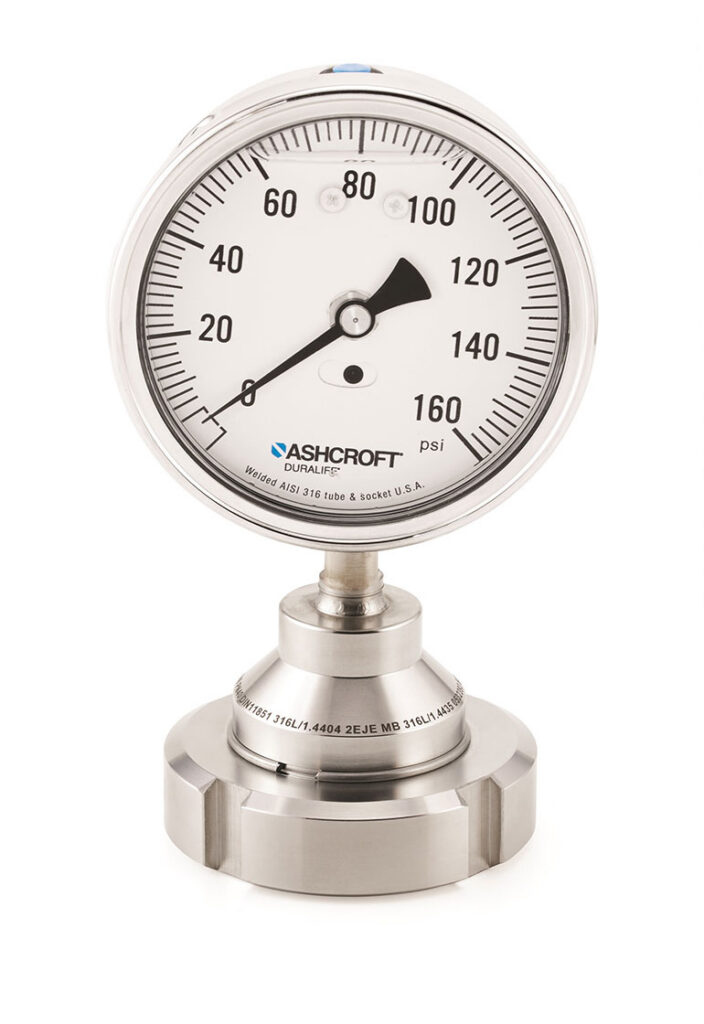
The Ashcroft 1033 sanitary gauge is 3A approved and is ideal for the food, pharmaceutical and cosmetic industries.
Key considerations include:
- What process media is this gauge exposed to? Material compatibility matters over time.
- Is this location subject to CIP or SIP cycles? Not all gauges are designed to survive repeated sterilization.
- What pressure range is required? Oversized ranges reduce accuracy; undersized ranges invite damage.
- Does this application require traceable calibration or certification? This is especially critical in pharmaceutical and regulated environments.
- How is the gauge mounted and clamped? Improper installation can introduce stress that affects readings.
- When was it last calibrated or evaluated? Accuracy drifts until it matters most.
- Pressure gauges are small, inexpensive, and easy to overlook. But in sanitary systems, they directly interface with product, pressure, and people. That makes them far more consequential than their size suggests.
The plants that experience the fewest surprises periodically question the assumptions baked into their systems, especially the ones that haven’t been revisited in years.
In sanitary systems, questioning instrumentation is a sign of operational maturity. Because when it comes to pressure gauges, the real risk isn’t failure; it’s complacency.
MCE Automation
mceautomation.com
Filed Under: Components, Components, Engineering Basics, Sensors & Gauges
