
If you’re tired of my missives about cars, this is your chance to click away. Conversely, if you enjoyed my article on enshittification (see our October issue and live link here), this example will make you pine for the good old days of automotive technology. “But Josh, what does hydraulics have to do with cars? The only thing hydraulic are the brakes!” Sadly, you’re mostly right.
However, until the past decade, the steering assist system on vehicles was hydraulic. The belt-driven, engine-powered hydraulic pump was as common as windshields, and despite disparities in execution, even the worst systems had benefits over today’s Novocain-numbed electric power-assist systems.
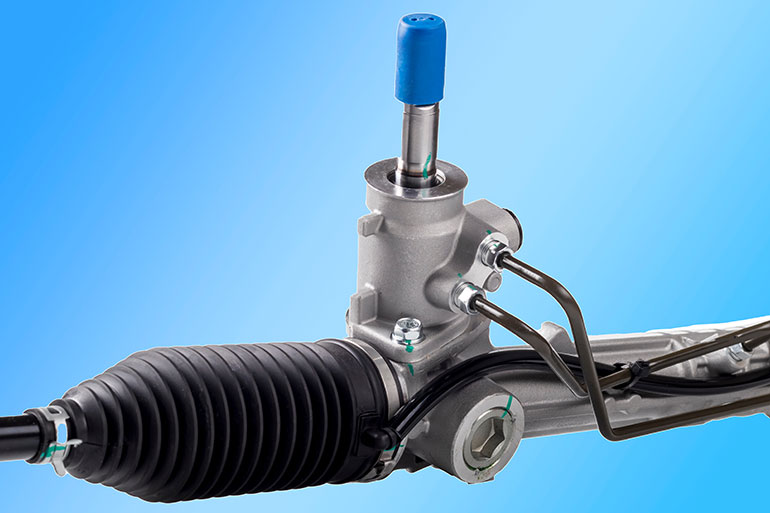
Example of a hydraulic steering rack used in motor vehicles
Let’s explore the differences between hydraulic and electric assist to elucidate why we find ourselves in a (nearly) hydraulics-free automotive climate. Steering a car is difficult without assist, especially at low speed. The static scrub friction between tires and asphalt increases the effort to pivot the wheels, but as vehicle speed increases, the rolling tire resets its contact patch continuously to realign the slip angle, easing up steering.
Car steering systems are not hydrostatic like those in a tractor, but rather hydraulic assist that aids an entirely mechanical system, allowing steering to persist despite a stalled engine or a failed pump. The mechanical portion is either rack-and-pinion or recirculating ball, and if you’re familiar with both, you’re just as baffled as I am that rack-and-pinion is the newer technology, but that’s neither here nor there.
When you rotate the steering wheel, the steering shaft drives a gear set that provides the mechanical advantage needed to overcome the massive tire friction. Without this advantage, it would be impossible to transmit enough force through the tie rods and into the steering knuckle. Hydraulic power steering systems add a double-rod cylinder to the mix, which is an embedded component of the rack itself. Above the pinion gear is a rotary valve that directs power steering fluid to the power steering piston, applying pressure to assist the rack’s movement.
Because hydraulic actuators are essentially just as stiff as mechanical systems, vibrations, resistance, feedback, and road texture are transmitted through the steering cylinder and hydraulic hoses. The self-aligning torque from the suspension caster angle is also transmitted through the steering wheel, resulting in the sensation that the steering wheel becomes harder to turn under hard cornering load.
When manufacturers began to switch to electric-assist power steering, they installed the electric motor to run in parallel with the rack via a gearbox. The electric motor has its own rotational inertia that must be overcome to “power” the rack and is often slow to respond. As well, the many gears and/or worm drives contain gaps, backlash, and play that eliminate the “solid column” feel with mechanical and hydraulic assist.
Today, nearly all passenger cars use electric assist. It eliminates the parasitic energy loss caused by hydraulic pumps and operates only when steering input is sensed at the steering wheel, relegating steering to an “on-demand” system. However, hydraulic steering is, in fact, so superior at transmitting road feel and precision that a few manufacturers refuse to switch to electric assist just to save a fraction of an MPG. And if hydraulic assist is still good enough for Lotus, McLaren and Bugatti, it’s good enough for me.
Filed Under: Components
