Fluid Power World

  • Home
  • Technologies
    • Hydraulics
      • Cylinders & Actuators
      • Filtration/Contamination Control
      • Fittings, Couplings & Adapters
      • Fluids
      • Fluid Conditioning
      • Hose & Tubing
      • Pumps & Motors
      • Related Technologies
      • Sealing
      • Sensors & Gauges
      • Valves & Manifolds
    • Pneumatics
      • Air Preparation & Regulation
      • Compressed Air Technologies
      • Cylinders & Actuators
      • End Effectors & Grippers
      • Fittings, Couplings & Adapters
      • Hose & Tubing
      • Sensors
      • Vacuum
      • Valves & Manifolds
  • Engineering Basics
  • Trending
  • Resources
    • Digital Issues
    • Pneumatics Tech Toolbox
    • Podcasts
    • Special Reports
    • Subscribe to Fluid Power World Print Magazine
    • Videos
    • Webinars / Digital Events
    • White Papers
  • Women in Engineering
    • Women in Fluid Power
    • Women in Engineering
  • Design Guides
  • Classrooms
    • Hydraulic Filtration
    • Hydraulic System Design
    • Pneumatics Classroom
  • Advertise
  • SUBSCRIBE

OxiStop tank prevents contamination and cavitation

By Mary Gannon | July 1, 2016

Share
Hydac-OxiStop

Hydac OxiStop

Any hydraulic system user must take contamination and cavitation prevention seriously, as these two activities can severely damage components and machinery.

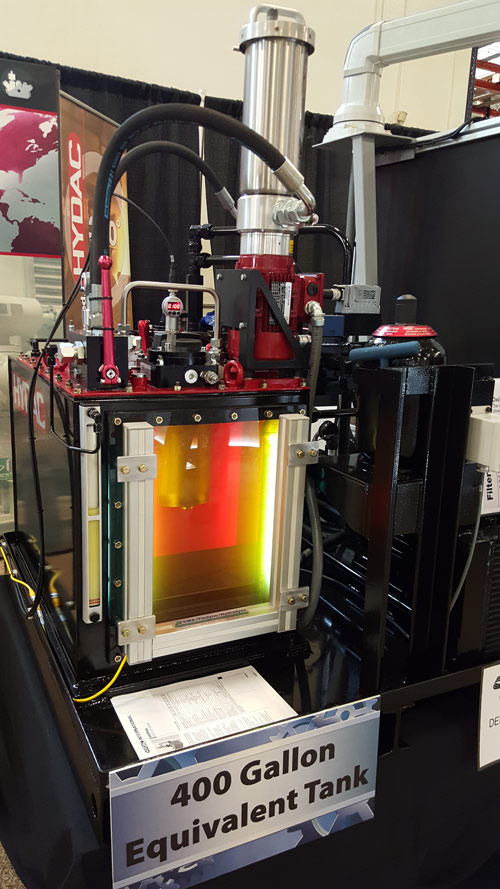
One such answer to these problems is HYDAC’s OXiStop LID series, a tank solution for hydraulic systems with an integrated, hydraulically driven degassing and dewatering unit. It is designed to be installed in extremely dusty or humid environments. It easily removes water and air from a system, said Daniel Zoller, Group Product Manager Filter Systems at HYDAC/Schroeder Industries.

Zoller added that the OxiStop eliminates cavitation. This is because the sealed system prevents dirt and air from being pulled in from the atmosphere. An integrated membrane prevents direct contact with the ambient air.

By reducing the tank size and removing air, you can reduce oil volume by a factor of 10. Fluid flows in and out of the tank as needed. For example, a 30 liter (a tank of approximately 40-45 gal) unit can replace a 400 gal typical tank.

Users select the tank for the differential operating volume actually needed, which reduces its size. They are available in three sizes of up to a differential volume of 30, 45 and 70 liters. Custom designs are also available.

A kidney loop system continuously runs and provides flow to the system. It features a top-loaded filter rated for 2µm.

The pump flow rate is not important for the tank design. In addition, the membrane helps the fluid stay “vacuum packed.” The pump and tank operation prevents settling time. And because you can reduce the air in the system, you can increase the bulk modulus of the oil, Zoller said, which makes it stiffer. This, in turn, increases energy efficiency while reducing costs of fluid required.

Users can choose to equip the OXiStop with an optional return line filter, water/oil cooler as well as with the AquaSensor AS and the ContaminationSensor CS.

The system also increases oil service life, reduces oxygen content by 80% and reduces contamination ingression (solid, liquid, gaseous). An added bonus is reduced noise due to reduced cavitation.

HYDAC
www.hydac.com

The post OxiStop tank prevents contamination and cavitation appeared first on Sealing & Contamination Control Tips.


Filed Under: News


About The Author

Mary Gannon

Mary Gannon is editor of Fluid Power World. She has been a technical writer and editor for more than 13 years, having covered fluid power, motion control and interconnect technologies.

Current Digital Issue

Fluid-Power-World-October-2026-issue-Cover-feature-image-template-copy

  A note from the editor In our October issue of Fluid Power World, my commentary takes a look at the growing role of automation and sensors in mobile machinery, where OEMs are increasingly focused on automating specific functions and improving machine performance rather than chasing fully autonomous equipment. Josh Cosford gets cheeky comparing the auto…

View Back Issues

Subscribe!

Fluid Power World is written by engineers for engineers engaged in designing machines and or equipment in Off-Highway, Oil & Gas, Mining, Packaging, Industrial Applications, Agriculture, Construction, Forestry, Medical and Material Handling. Fluid Power World covers pneumatics, mobile hydraulics and industrial hydraulics.

Fluid Power Design Guides

fluid
“fpw
EXPAND YOUR KNOWLEDGE AND STAY CONNECTED
Get the latest info on technologies, tools and strategies for Fluid Power Professionals.

RSS feed: Featured White Papers Featured White Papers

  • Moving fluid power forward
  • High-force linear motion: How to convert from hydraulic cylinders to electric actuators and why.
  • A technical comparison: Performance of pneumatic cylinders and electric rod actuators
Fluid Power World
  • Hose Assembly Tips
  • Mobile Hydraulic Tips
  • Pneumatic Tips
  • Sealing & Contamination Control Tips
  • About us
  • Contact Us

Copyright © 2026 Arrowfly LLC. All Rights Reserved. The material on this site may not be reproduced, distributed, transmitted, cached or otherwise used, except with the prior written permission of Arrowfly
Privacy Policy | Advertising | About Us

Search Fluid Power World

  • Home
  • Technologies
    • Hydraulics
      • Cylinders & Actuators
      • Filtration/Contamination Control
      • Fittings, Couplings & Adapters
      • Fluids
      • Fluid Conditioning
      • Hose & Tubing
      • Pumps & Motors
      • Related Technologies
      • Sealing
      • Sensors & Gauges
      • Valves & Manifolds
    • Pneumatics
      • Air Preparation & Regulation
      • Compressed Air Technologies
      • Cylinders & Actuators
      • End Effectors & Grippers
      • Fittings, Couplings & Adapters
      • Hose & Tubing
      • Sensors
      • Vacuum
      • Valves & Manifolds
  • Engineering Basics
  • Trending
  • Resources
    • Digital Issues
    • Pneumatics Tech Toolbox
    • Podcasts
    • Special Reports
    • Subscribe to Fluid Power World Print Magazine
    • Videos
    • Webinars / Digital Events
    • White Papers
  • Women in Engineering
    • Women in Fluid Power
    • Women in Engineering
  • Design Guides
  • Classrooms
    • Hydraulic Filtration
    • Hydraulic System Design
    • Pneumatics Classroom
  • Advertise
  • SUBSCRIBE