
A popular new system for improving responsiveness and efficiency, especially on mobile equipment, is to decentralize the hydraulic system. Mobile machinery, especially electric ones, can do away with massive reservoirs, huge pumps, bulky valve manifolds, and the extensive plumbing networks used to send controlled fluid to actuators throughout the machine.
Such decentralized systems instead use electrohydraulic actuators, which are self-contained hydraulic systems based around the operation and control of a single hydraulic cylinder. Each assembly includes the electric motor, pump, reservoir, valve, filter, and accessories, as well as the cylinder itself. Every manufacturer has its own take on these: some build wide, some tall, and some long.
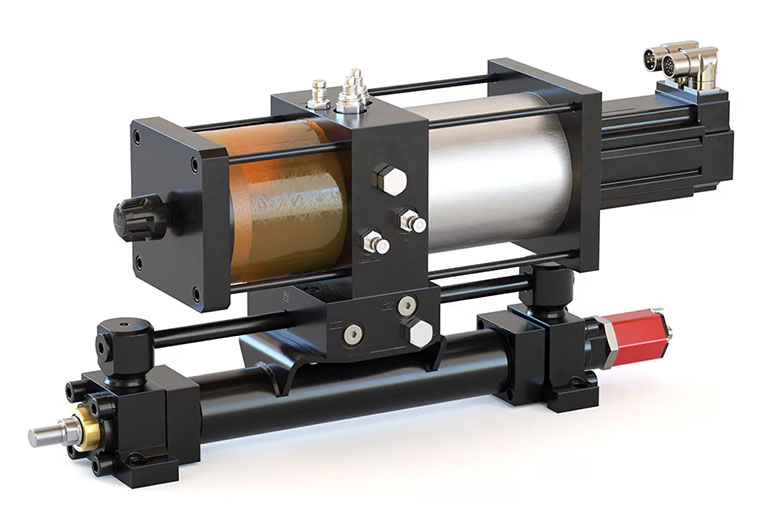
Parker Hannifin’s HAS 500 Series’ hybrid design combines the controllability of electromechanical actuators with the durability of a traditional hydraulic system in an all-in-one actuation system that eliminates the need for a hydraulic power unit, hoses and valving.
In an electric machine, each actuator operates only when required, using only as much pressure, flow, and energy as needed for the designated function at any given time, and no more. No single pump and prime mover that operates continuously and uninterrupted is needed, saving energy while reducing the size of major components. But in the factory, does such a hydraulic system make sense, where restrictions on carbon emissions are less severe?
A centralized hydraulic system uses a single hydraulic power unit with an electric motor and hydraulic pump combination large enough to handle maximum demand. If during peak demand the pump outputs 100 gpm, it matters not that any given cylinder needs just 5 gpm for off-peak operation, because the entire hydraulic package must suit the worst-case scenario. This leads to heat generation, excess wear, increased maintenance, and unnecessary noise.
Decentralizing your industrial hydraulics means installing electrohydraulic actuators at the point of use, which encourages out-of-the-box thinking about how a hydraulic machine should look. Hydraulic functions don’t need to be kept within a reasonable distance of the “main machine,” because no hoses or plumbing are required.
Additionally, electrohydraulic actuators are highly responsive, since servo or proportional valves may be mounted directly to the cylinder. This setup leverages the low fluid volume to achieve tighter control and faster response. High-speed, precise functions are unmatched, and the only requirements are electrical power and control signals.
Decentralized hydraulics suits the upcoming wave of modular and configurable machinery. Production lines will be flexible cells in plants that frequently reconfigure for different production lines, rather than focusing on one line making millions of the same thing, where traditional machinery and automation shine.
Actuators will also share components, making maintenance and repair simpler and less expensive. Rather than stocking one large pump, for example, stocking a couple of the small pumps the electrohydraulic actuators use will reduce maintenance inventory costs and speed up component replacement time. Additionally, other parts of a machine may remain online if only one actuator needs to be replaced or repaired, thereby increasing productivity.
The downside, of course, comes with the initial investment. Instead of a single power unit, each cylinder now uses its own pump, filter, tank, and valves. As you’d suspect, electrohydraulic actuators are expensive because of this. However, the benefits of modularity, flexibility, and increased productivity may show beneficial as more decentralized systems find a home in the industrial factory.
Filed Under: Components, Cylinders & Actuators, Electrification, Pumps & Motors, Trending
