
Tunnel boring machines, which perform several operations underground, require advanced systems to ensure hydraulic systems remain dry and contaminant free.
The complexity of tunnel boring machines is vast. These massive machines ensure continuous forward progress, transport excavated material, install concrete segments for tunnel lining and maintain the stability of the tunnel face. They are usually more than 100 m in length, integrating the cutterhead, trailing gear segments, conveying technology and energy supply. The available space within the tunnel cross-section is extremely limited. Tunnel boring machines can have hundreds of meters of hydraulic lines, multiple hose connections and many sealing points exposed to humid underground environments. On a tunnel boring machine, water can enter through ambient humidity, condensation, cooling systems, leaking seals and the many hose connections and sealing points throughout the hydraulic network. High groundwater pressure and changing temperatures can add to that exposure.
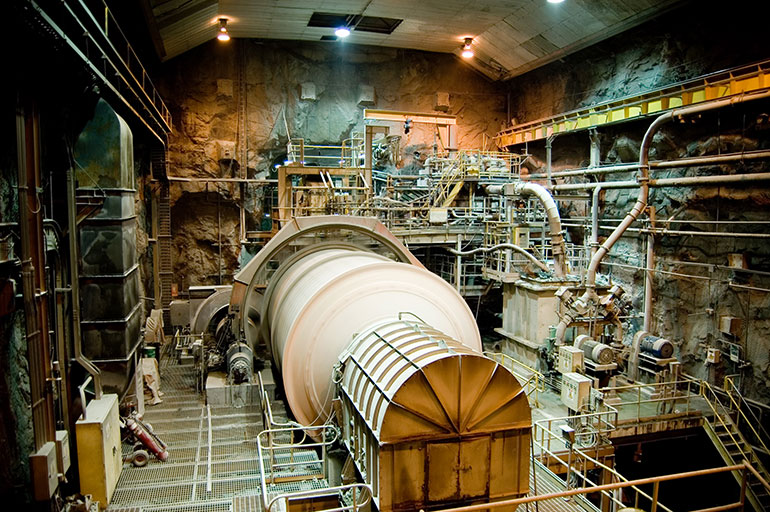
The complicated nature of tunnel boring machines, as well as the highly humid and dirty underground environments in which they operate, means they require constant care of all their hydraulic fluid systems. Image courtesy of Getty Images
“Tunnel boring machines can present a particularly demanding hydraulic environment, with long piping runs, numerous connections and seals, temperature changes and limited space for additional equipment. In many applications, these systems also operate in wet, contamination-prone underground conditions where minimizing downtime and maintenance interruptions is important,” said Simone Ortner, Hydraulic Filtration Engineering and Product Manager, Eaton Filtration Division.
Water can enter hydraulic fluid not only in dissolved form but also as free or emulsified water, which often cannot be removed using conventional filters, centrifuges or separators. Any water presents a significant risk to the operational safety of tunnel boring machines. It attacks metallic components such as valves, pumps, cylinders and piping which facilitates corrosion and causes leaks. It also degrades the lubricating properties of the fluid, increases friction and accelerates wear. Finally, it speeds up oxidative aging processes, promotes sludge and varnish formation and impairs the function of finely tuned hydraulic components.
Eaton’s solution for this risk is using the IFPM 10 fluid purifier system, as it packages vacuum dehydration, degassing and particulate filtration into a compact and mobile offline unit, Ortner said. “The vacuum process is particularly important because it is designed to help remove dissolved and emulsified water, as well as free water, from the hydraulic fluid. The conditioned fluid then passes through an integrated particulate filter before returning to the tank,” she continued. “That means the IFPM 10 can address several contamination mechanisms in one process. The unit is also fully automatic and PLC controlled, which can help reduce the amount of manual intervention required during fluid conditioning.”
Ortner explained the difference between contaminant filtration and water dehydration. “Particulate contamination is generally more straightforward because solid particles can be captured by a properly selected filter. Water behaves differently because it can be present as free, emulsified or dissolved water. Dissolved water is particularly difficult to control because conventional particulate filters do not remove it, and centrifuges or separators may not remove it effectively,” she said.
“That is why simply adding a finer filter does not solve the whole problem. The IFPM 10 uses vacuum evaporation to help remove free, emulsified and dissolved water, as well as free and dissolved gases. The dehydrated fluid then passes through an integrated spin-on filter that retains particulate contamination before the fluid is returned to the reservoir,” she concluded.
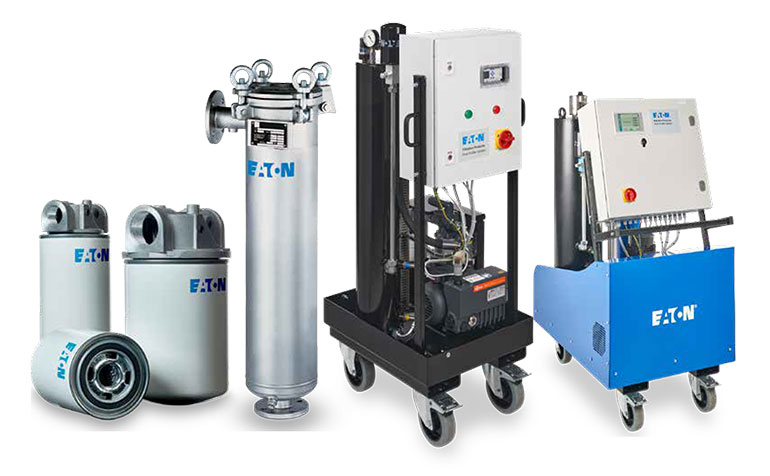
left to right: Eaton spin-on filters, SIDELINE-single-bag-filter-housing, ifpm 10 fluid purifier system, and ifpm 73 fluid purifier system. Image courtesy of Eaton
Hydraulic oil is not the only fluid that may require filtration on a tunnel boring machine, however. In many applications, closed-loop cooling-water circuits are also used to manage heat around critical components such as the cutting wheel. Because the water may be continuously recirculated through the system and a heat exchanger, it requires its own filtration approach.
In these applications, bag filtration can be used to capture particulate contamination from the cooling water before it continues through the loop. Eaton Sideline 16-bar bag-filter housings may be used with 150- or 200-micron monofilament filter bags for this type of service. Depending on the system design and required availability, the setup may use a single housing or multiple housings, including a run-and-standby duplex configuration that allows one side to remain in service while the other is taken offline for maintenance.
This system is often used as needed, and there is no set time on how long it can take to ensure hydraulic fluid is water free, Ortner said, because it depends on the reservoir volume, the initial water concentration, the rate at which new contamination is entering the system and the cleanliness target the operator is trying to achieve. “The IFPM 10 has a published flow rate of up to approximately 9 to 10 lpm and a water-removal capacity of up to about 3 liter per day, depending on operating conditions. Those figures can help with application sizing, but they should not be interpreted to mean the entire hydraulic system will be ‘clean’ after one reservoir turnover. Water is removed progressively as the fluid circulates through the purifier, so reaching the desired condition may require multiple cycles.”
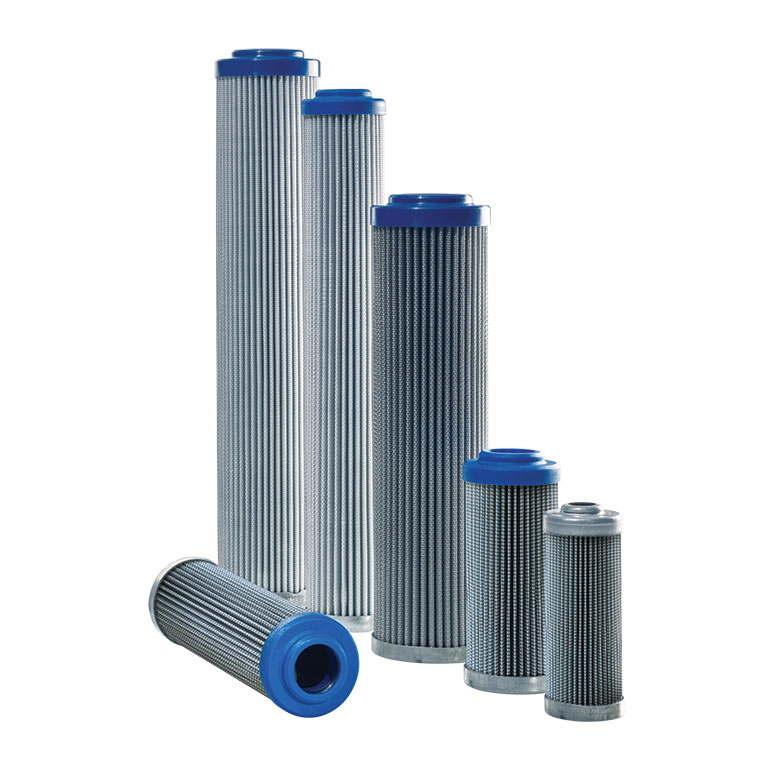
01.E pressure filter elements protect system components such as valves and hydraulic motors. Image courtesy of Eaton
In many applications, the IFPM 10 may be used as needed rather than operated continuously. When integrated with the machine’s control system and fluid-condition monitoring, operators can use water-saturation data to help determine when purification is needed and when the desired fluid condition has been restored.
Ortner said that offline conditioning should be viewed as a preventive reliability tool. “Oil changes can remove contaminated or degraded fluid, but they do not prevent new contamination from entering the system. A traditional kidney loop can be effective for controlling particulates, but its ability to address water depends on the technology built into the system, and a conventional filter element will not remove dissolved water. By the time fluid degradation or component damage becomes visible, wear, corrosion or oxidation may already be underway,” she said.
“An offline purifier can help engineers manage fluid condition while supporting continued operation of the main system. The goal is to help keep the oil within an acceptable operating range, maintain its lubricating properties and extend the useful life of the fluid and hydraulic components. Water saturation also deserves particular attention because free water can alter fluid properties and contribute to corrosion and other damage,” she continued. “Eaton advises customers to keep water saturation below 70% to help minimize the risk of free water building up. Oil analysis, sealing and breather practices, filtration and offline purification should therefore be viewed as complementary parts of a broader contamination-control strategy.”
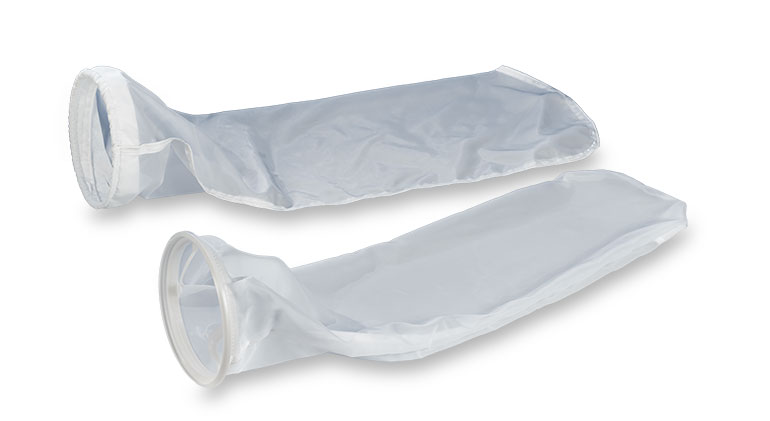
bag filtration using eaton’s monofilament filter bags captures particulate contamination from cooling water before it moves through the loop system. Image courtesy of Eaton
There is limited space to play when it comes to machines like tunnel borers, and it’s important to consider capacity versus footprint, Ortner said. Eaton’s purifier technology is available in several sizes so engineers can evaluate the system against both fluid volume and the available installation space. According to published product specifications:
- IFPM 10 provides a flow rate of up to approximately 10 lpm and water-removal capacity of up to approximately 3 liters per day.
- IFPM 33 provides up to approximately 29 lpm and up to approximately 22 liters of water removal per day.
- IFPM 73 provides up to approximately 72 lpm and up to approximately 54 liters of water removal per day.
Eaton also offers stationary IFPS units for applications where a fixed installation is preferred.
Placement is another important consideration and should be evaluated for the specific machine and operating environment. In general, shorter hose runs can help limit flow resistance, while longer hoses can reduce the volume flow rate through the purifier and affect overall efficiency. The unit should also be positioned with operation, maintenance access and protection from damage in mind. Suction and return points, hose routing, elevation and inlet conditions should be determined using Eaton’s installation guidance for the specific application.
Ortner said that as contamination monitoring and fluid conditioning evolve to support more automated and data-driven equipment in mining, she expects there will be closer integration between fluid-condition monitoring and purification equipment. “Moisture-, particle- and oil-condition data could be incorporated into equipment maintenance systems, allowing operators to identify contamination trends earlier and make decisions based more on actual fluid condition than on fixed service intervals,” she said. “Over time, that could create a more connected process in which monitoring data indicates when purification is needed, tracks whether fluid condition is improving, and helps teams distinguish between a temporary event and a persistent issue elsewhere in the hydraulic system. The IFPM platform’s automated, PLC-controlled operation may provide a useful foundation for that type of approach. One possible direction is deeper integration between purification equipment, condition-monitoring sensors and broader equipment reliability data.”
Eaton
eaton.com
Note: Application requirements vary, and customers should consult Eaton product literature and technical representatives to confirm appropriate product selection, installation and maintenance practices for their specific equipment and operating conditions.
Filed Under: Components, Contamination Control, Engineering Basics, Filtration, Filtration/Contamination Control
