
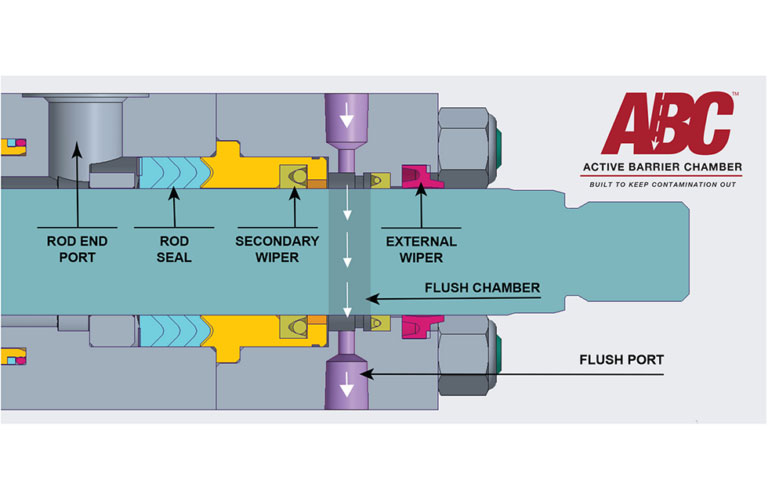
Milwaukee Cylinder has launched its Active Barrier Chamber (ABC) technology, an innovative cylinder solution designed for highly contaminated environments. The system uses an active flush chamber and secondary wiper seal, in addition to the primary wiper, to dislodge and continuously flush contaminants from the rod before they can reach the rod seals. This active contamination removal helps protect the rod seals, piston seals, and cylinder tube, extending cylinder service life and improving uptime in demanding industrial applications.
As modern manufacturing demands higher uptime, industrial operators face persistent challenges with premature component failure due to environmental contamination. Traditional passive wipers often allow finer particles to enter the cylinder, leading to rod seal degradation, piston wear, internal scoring, and costly unplanned downtime. The new cylinder directly addresses these vulnerabilities by replacing passive defense with active contamination removal.
ABC technology was designed to address very dirty or harsh environments. The goal is to keep the working fluid to a cleanliness level of ISO 17/15/12.
Key features and engineering advancements of the new cylinder line include:
- Active Flush Chamber: Features a dedicated, sealed flush chamber positioned directly behind the primary wiper. Continuous low-pressure fluid flow actively captures and removes abrasive contaminants from the rod before they can reach the rod seal area. This low-pressure fluid flow can be driven in two ways. It could be a separate branch of the main hydraulic power unit (HPU). It would be done by teeing off a separate line with a pressure reducing and check valve. The check valve prevents the flushing fluid from going back to the main pump. The reduced pressure is for the active barrier chamber. The output of the ABC fluid would need to go to a separate filter before going back to the reservoir. Additionally, the other option would be a standalone HPU to create the closed fluid power loop system.
- Dual-Layer Wiper Protection: Integrates a secondary internal wiper seal that provides a critical secondary barrier. As contaminants travel along the rod, the secondary wiper dislodges them from the rod surface, allowing the flushing fluid to capture and remove them from the chamber before they can reach the rod seals.
- Mounting Flexibility: ABC technology is available on Milwaukee Cylinder H-Series cylinders with all mounting configurations, making it easy to apply across a wide range of new and existing applications.
According to Tom Florence, the engineer working this design, the flushing mechanism works by using fluid to actively flush particles off of the rod. “It differs from the multi wiper approach in that it does the wiping external to the rod bushing (ie; it doesn’t allow the contaminants to enter the bushing). We think this is a superior design because it stops the contamination before it’s able to damage the bushing,” he said. “The theory is that the constant rotation of fluid in the flush chamber will carry away more contaminants than without.”
The technology is only available on new cylinder builds and not for retrofit, Florence said. “Engineering requirements are either modifying the current fluid power circuit (to add the t line) or purchasing a separate standalone unit. In regard to costs, we expect a slightly larger investment upfront with the impact being less downtime,” he said. “Overtime, the maintenance requirements are going to be monitoring the ABC return line filter as we would expect its filter to reach its end of life sooner because it’s cleaning more particles from the fluid. Because of this, the costs would be replacing filters for the flush return.”
It does consume additional fluid but will increase seal life, Florence noted. “We expect it to increase rod seal life which will decrease the amount of maintenance needed on the primary cylinder seals,” he said. “With the ABC system, there are three additional seals (two that seal the chamber fluid and the external wiper) that need to be monitored for wear and tear over time.”
“Our ABC technology is a great solution for highly contaminated environments and another example of how Milwaukee Cylinder continues to lead the industrial cylinder market through innovation,” said Douglas Lacina, President of Milwaukee Cylinder.
Milwaukee Cylinder
www.milwaukeecylinder.com
Filed Under: Components, Cylinders & Actuators, News, Sealing, Seals
