Fluid Power World

  • Home
  • Technologies
    • Hydraulics
      • Cylinders & Actuators
      • Filtration/Contamination Control
      • Fittings, Couplings & Adapters
      • Fluids
      • Fluid Conditioning
      • Hose & Tubing
      • Pumps & Motors
      • Related Technologies
      • Sealing
      • Sensors & Gauges
      • Valves & Manifolds
    • Pneumatics
      • Air Preparation & Regulation
      • Compressed Air Technologies
      • Cylinders & Actuators
      • End Effectors & Grippers
      • Fittings, Couplings & Adapters
      • Hose & Tubing
      • Sensors
      • Vacuum
      • Valves & Manifolds
  • Engineering Basics
  • Trending
  • Resources
    • Digital Issues
    • Pneumatics Tech Toolbox
    • Podcasts
    • Special Reports
    • Subscribe to Fluid Power World Print Magazine
    • Videos
    • Webinars / Digital Events
    • White Papers
  • Women in Engineering
    • Women in Fluid Power
    • Women in Engineering
  • Design Guides
  • Classrooms
    • Hydraulic Filtration
    • Hydraulic System Design
    • Pneumatics Classroom
  • Advertise
  • SUBSCRIBE

Piston accumulator fundamentals

By Mary Gannon | October 6, 2026

Share

Piston accumulators are perhaps the most overlooked of their ilk, often standing out of the spotlight in which diaphragm and bladder accumulators bask. In fact, piston accumulators are superior to other types in more ways than they are inferior, so this article aims to set the record straight on why you should (or shouldn’t) select them for your application.

Some manufacturers offer ultra-high-pressure diaphragm accumulators, but it’s rare for bladder accumulators to withstand more than 5,000 psi of working pressure. However, there is nothing inherently disadvantageous about a piston accumulator’s strength, since tube wall thickness is not limited, and modern sealing technology readily permits both high speed and high pressure. Most manufacturers advertise 10,000 psi options in their catalogs, although going much higher is a challenge for nitrogen precharging more than it is creating a robust accumulator.
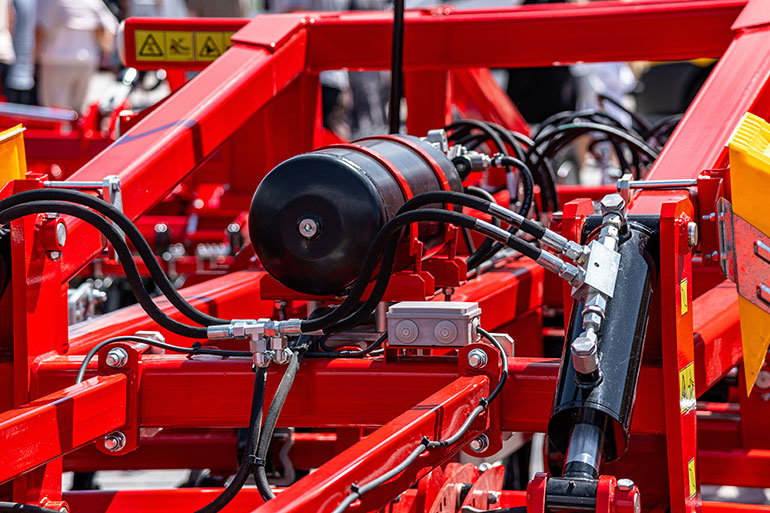
piston-accumulators-AdobeStock_2101541716

It’s not unreasonable to use a 24-in. diameter barrel material on a piston accumulator, so imagine the fluid capacity and flow rate potential of such large sizes. While diaphragm and bladder accumulators rarely hold more than 1 or 15 gallons, respectively, some manufacturers offer piston designs capable of storing 200 gallons of pressurized fluid, ready to power small hydraulic machines for minutes straight or to supplement high flow rates when demand is high.

Because no bladder or diaphragm expands and contracts infinitely under pressure, a piston accumulator achieves an atmospheric compression ratio (the ratio of fluid stored to fluid discharged) by comparison. There is no minimum pressure a piston accumulator must be maintained at, and it can exhaust all its fluid down to zero psi with no trouble. Meanwhile, their cousins are restricted to an 8:1 compression ratio for diaphragm, and only 4:1 for bladder accumulators.

Piston accumulators are generally easier to service. Rather than replacing the entire bladder, you can remove the cap, pull out the piston, and replace only the seals. In a pinch, you can even replace the seals with those sourced locally from your preferred seal supplier, which is useful if you cannot get the factory seal kit quickly enough. And even when a piston seal starts to leak, the accumulator will still function, while bladders and diaphragms generally fail catastrophically.

This repair conversation segues perfectly into the downsides of piston accumulators. Because piston seals do leak eventually, the exchange of oil and nitrogen can also lead to the exchange of contamination past a piston seal. Any contamination that passes the piston seal package is likely to be dragged along for the ride, further damaging the seals or the barrel wall itself.

Generally, where bladder and diaphragm accumulators excel, piston accumulators struggle. Because of the piston’s significant mass, it struggles to respond rapidly to transients and oscillations. Diaphragm accumulators are responsive enough to absorb high-frequency vibrations, such as those produced by pumps as their gears or pistons “pop” fluid into the pressure chamber of their cases.

And while bladder accumulators respond nearly instantly to the pressure differential between the gas and fluid sides, piston accumulators cannot provide the same response time when called upon to stabilize system pressure during transients (which is why you should select long, skinny piston accumulators for quick transients over short, fat ones).

Finally, piston accumulators are not the cheapest option for your pressurized fluid storage. They’re generally made to order because they come in myriad bore sizes and lengths, ranging from 2 in. ID all the way to 24 in. or more, and are also offered from 8 in. through to stretches of 220 in. or longer. Despite their limitations, select a piston accumulator if you require the highest possible flow and/or the highest total volume.


Filed Under: Accumulators, Components, Engineering Basics


About The Author

Mary Gannon

Mary Gannon is editor of Fluid Power World. She has been a technical writer and editor for more than 13 years, having covered fluid power, motion control and interconnect technologies.

Current Digital Issue

Fluid-Power-World-October-2026-issue-Cover-feature-image-template-copy

  A note from the editor In our October issue of Fluid Power World, my commentary takes a look at the growing role of automation and sensors in mobile machinery, where OEMs are increasingly focused on automating specific functions and improving machine performance rather than chasing fully autonomous equipment. Josh Cosford gets cheeky comparing the auto…

View Back Issues

Subscribe!

Fluid Power World is written by engineers for engineers engaged in designing machines and or equipment in Off-Highway, Oil & Gas, Mining, Packaging, Industrial Applications, Agriculture, Construction, Forestry, Medical and Material Handling. Fluid Power World covers pneumatics, mobile hydraulics and industrial hydraulics.

Fluid Power Design Guides

fluid
“fpw
EXPAND YOUR KNOWLEDGE AND STAY CONNECTED
Get the latest info on technologies, tools and strategies for Fluid Power Professionals.

RSS feed: Featured White Papers Featured White Papers

  • Moving fluid power forward
  • High-force linear motion: How to convert from hydraulic cylinders to electric actuators and why.
  • A technical comparison: Performance of pneumatic cylinders and electric rod actuators
Fluid Power World
  • Hose Assembly Tips
  • Mobile Hydraulic Tips
  • Pneumatic Tips
  • Sealing & Contamination Control Tips
  • About us
  • Contact Us

Copyright © 2026 Arrowfly LLC. All Rights Reserved. The material on this site may not be reproduced, distributed, transmitted, cached or otherwise used, except with the prior written permission of Arrowfly
Privacy Policy | Advertising | About Us

Search Fluid Power World

  • Home
  • Technologies
    • Hydraulics
      • Cylinders & Actuators
      • Filtration/Contamination Control
      • Fittings, Couplings & Adapters
      • Fluids
      • Fluid Conditioning
      • Hose & Tubing
      • Pumps & Motors
      • Related Technologies
      • Sealing
      • Sensors & Gauges
      • Valves & Manifolds
    • Pneumatics
      • Air Preparation & Regulation
      • Compressed Air Technologies
      • Cylinders & Actuators
      • End Effectors & Grippers
      • Fittings, Couplings & Adapters
      • Hose & Tubing
      • Sensors
      • Vacuum
      • Valves & Manifolds
  • Engineering Basics
  • Trending
  • Resources
    • Digital Issues
    • Pneumatics Tech Toolbox
    • Podcasts
    • Special Reports
    • Subscribe to Fluid Power World Print Magazine
    • Videos
    • Webinars / Digital Events
    • White Papers
  • Women in Engineering
    • Women in Fluid Power
    • Women in Engineering
  • Design Guides
  • Classrooms
    • Hydraulic Filtration
    • Hydraulic System Design
    • Pneumatics Classroom
  • Advertise
  • SUBSCRIBE