
Contributed by Michael Cook, Global Segment Director Off-Highway, Trelleborg Sealing Solutions

Michael Cook, Global Segment Director Off-Highway, Trelleborg Sealing Solutions
Hydraulic cylinders no longer operate in predictable, controlled conditions. They are pushed through wider temperature ranges, higher pressures and longer duty cycles than ever before, all the while adapting to new fluids and tightening regulatory requirements. For OEMs, this shift raises a question: can a single component, tested and optimized in isolation, still deliver reliable performance? Increasingly, the answer is no.
From dependable workhorse to endurance performer
Not long ago, a hydraulic cylinder operated like a family car: dependable, predictable and rarely pushed to its limits. Today, that same cylinder is expected to perform like a vehicle in a 24-hour endurance race, moving from Arctic cold to desert heat while switching fuel types along the way.
Customers demand longer duty cycles, wider temperature variations and sealing systems that perform at higher pressures. At the same time, regulatory change is accelerating. New fluid formulations require ongoing compatibility checks. The shift toward PFAS-free materials and chrome-free counter surfaces means sealing solutions built for yesterday’s specifications may no longer hold up under today’s requirements. The market is being redefined, and sealing needs are being redefined along with it.
Rethinking materials and design together
Regulatory shifts around PFAS materials have forced a hard look at alternatives to polytetrafluoroethylene (PTFE) polymer compounds, which have long been central to sealing performance. Polyurethane and other plastics must now be evaluated on whether they can match PTFE performance over time and across demanding operating conditions.
The critical insight is that materials cannot be assessed in isolation. A new polymer formulation typically performs well when paired with a design engineered specifically for it. Traditional seal geometries built around established materials do not always transfer cleanly to new compounds. This has driven a broader rethink of how material science and design interact, treating them as a single integrated system rather than two separate disciplines. That shift has also opened the door to potentially expanding the use of materials not traditionally seen in the market for hydraulic sealing such as polyetheretherketone (PEEK) or polyamide (PA).
Simulation and testing at the system level
Meeting today’s performance demands for improved uptime, increased efficiency and longer equipment life requires moving away from generic, catalog-based products toward specialized systems engineering, without sacrificing commercial viability even for smaller production runs. That balance is only achievable through advanced digitalization.
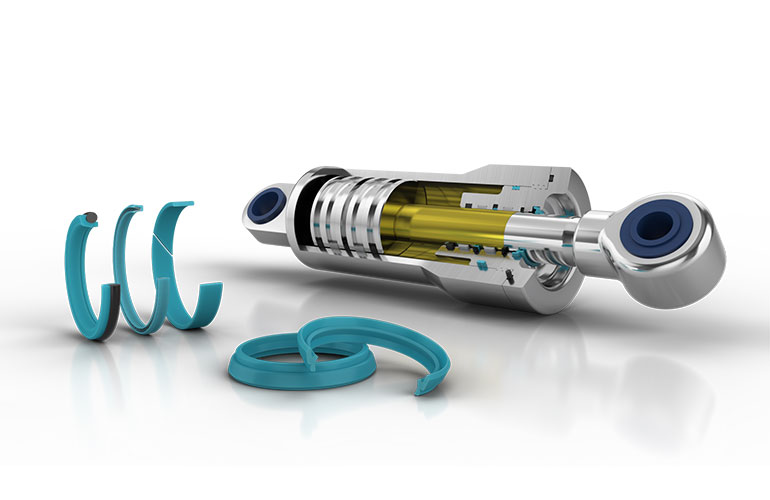
Trelleborg hydraulic seals
Testing every material and design combination physically would be prohibitively slow. A purely test-driven approach to today’s range of operating conditions could take years to bring a new product to market, by which point the requirements would have already changed. Instead, advanced simulation, including finite element analysis (FEA) built on proprietary material data, allows engineering teams to model performance across a full spectrum of conditions before narrowing down to selective physical testing for verification. Combining chemistry, physics and simulation into one holistic toolbox is what allows sealing systems to keep pace with application demands that are changing rapidly and continuously.
Moving from single components to total cost of ownership
Perhaps the most important shift for hydraulic OEMs is a change in how performance is measured. Sourcing the lowest-cost seal may seem prudent, but the upfront savings can be quickly outweighed by the cost of leakage, premature failure and unplanned downtime.
A systems approach changes the calculation. When sealing components, materials and designs are engineered together rather than sourced piecemeal, OEMs gain measurable advantages: fewer suppliers to manage, reduced verification burden through comprehensive system-level testing by the supplier and stronger protection of aftermarket revenue through advanced kitting and part marking.
Global standardization, local responsiveness
Delivering consistent sealing performance across global operations requires coordinated expertise. Think of it as a world-class orchestra: specialists positioned around the world, aligned so that best practice developed in one location benefits customers everywhere, without forcing every application into the same mold.
For OEMs operating across multiple regions, this matters because it removes the guesswork that comes with combining components from different suppliers, where a single scraper or fluid change can create unpredictable effects across the entire system. Sourcing an integrated sealing system, rather than a collection of individually sourced parts, gives OEMs a single point of accountability for how components interact under real operating conditions, while still allowing solutions to be adapted to local regulatory and application needs.
Early collaboration with sealing experts allows hardware design, material selection and sealing geometry to be optimized together, rather than retrofitted after the fact. When material and design decisions are made in isolation, without visibility into how components will interact, OEMs often end up combining solutions from different suppliers and settling for underwhelming system-level performance.
The path forward for hydraulic OEMs
The conditions hydraulic cylinders operate under will keep evolving: higher pressures, tighter efficiency demands and continued regulatory pressure on materials, fluids and surface coatings. OEMs that treat sealing as a system backed by advanced simulation, comprehensive testing and deep materials expertise will be better positioned to manage performance, cost and compliance together rather than as competing priorities.
Trelleborg Sealing Solutions
www.trelleborg.com/en/seals
Filed Under: Components, Engineering Basics, Sealing, Seals, Trending
