Fluid Power World

  • Home
  • Technologies
    • Hydraulics
      • Cylinders & Actuators
      • Filtration/Contamination Control
      • Fittings, Couplings & Adapters
      • Fluids
      • Fluid Conditioning
      • Hose & Tubing
      • Pumps & Motors
      • Related Technologies
      • Sealing
      • Sensors & Gauges
      • Valves & Manifolds
    • Pneumatics
      • Air Preparation & Regulation
      • Compressed Air Technologies
      • Cylinders & Actuators
      • End Effectors & Grippers
      • Fittings, Couplings & Adapters
      • Hose & Tubing
      • Sensors
      • Vacuum
      • Valves & Manifolds
  • Engineering Basics
  • Trending
  • Resources
    • Digital Issues
    • Pneumatics Tech Toolbox
    • Podcasts
    • Special Reports
    • Subscribe to Fluid Power World Print Magazine
    • Videos
    • Webinars / Digital Events
    • White Papers
  • Women in Engineering
    • Women in Fluid Power
    • Women in Engineering
  • Design Guides
  • Classrooms
    • Hydraulic Filtration
    • Hydraulic System Design
    • Pneumatics Classroom
  • Advertise
  • SUBSCRIBE

Compressed air fail: The forgotten compressed air energy users

By Paul Heney | November 2, 2026

Share

By Ron Marshall

Marcus, the maintenance technician, thought he had finally solved one of the plant’s biggest compressed-air problems. Over the previous several months, his team had worked steadily through a leak-repair program, tagging leaks, repairing fittings, replacing damaged hoses, and following up with ultrasonic checks.

The results were obvious during production. Compressor loading dropped, pressure became more stable, and Marcus could see that the repair work was paying off. But one thing still bothered him: the system was using far too much air during non-production hours.

On weekends and overnight shutdowns, when almost everything in the plant was idle, the compressors were still carrying a surprisingly high load. Marcus expected some residual demand, but the numbers were too large to explain by the few remaining leaks.

He started another walk-through, this time concentrating on equipment that normally received little attention. Instead of listening only for leaks at hoses and fittings, he began looking at the condensate drains installed under his receivers, filters, dryers, separators, and low points in the piping. That is when the real problem started to appear.

The first drain he checked was discharging continuously. There was no condensate coming out, just a steady stream of compressed air. A second drain was doing the same thing, then a third. By the time Marcus worked his way through the compressor room and distribution system, he found more than half a dozen automatic drains stuck wide open. Each one looked insignificant by itself, but together they represented a continuous demand that never stopped, even when production did.

Marcus also found the opposite problem. Several other drains were blocked with rust, scale, and contamination. These units were no longer removing condensate at all. Water had collected upstream and was being carried into filters and downstream equipment, creating a reliability problem while the failed-open drains were creating an energy problem. Suddenly the high non-production load made sense.
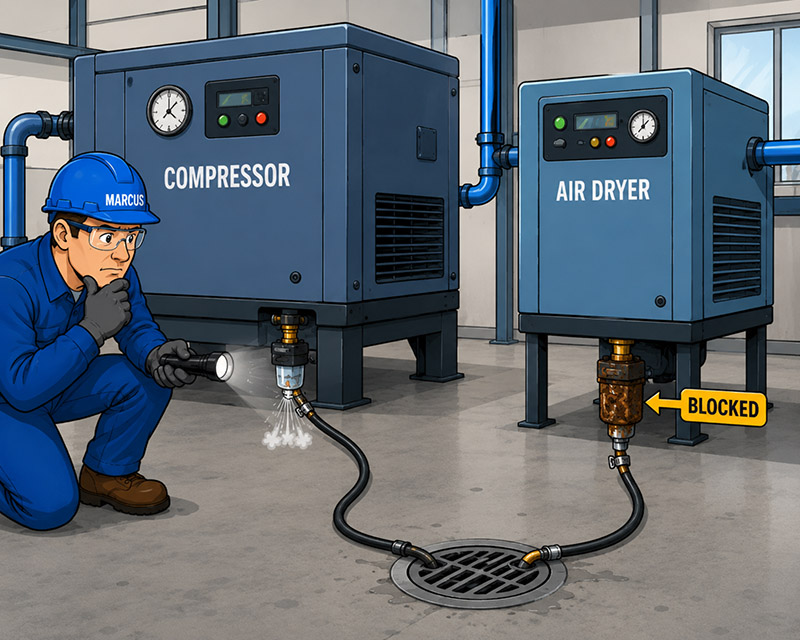
Fig. 1. Compressed air drains are an item that needs regular attention in most compressor rooms. These can stick open, wasting air, or worse not work at all allowing moisture and lubricants to build up inside components and piping.

Marcus realized that his leak program had been focused mainly on what could be heard or detected around production equipment. The condensate drains had never really been considered compressed-air users, yet some of them had effectively become permanent artificial demands.

The team repaired or replaced the failed drains, cleaned the blocked units, and added drain inspection to the regular maintenance schedule. Marcus also began checking whether drains opened only when condensate was present and closed completely afterward. The next non-production test told the story. Compressor loading dropped noticeably, confirming that the drains had been responsible for a large portion of the remaining demand.

The experience changed the way Marcus looked at compressed-air maintenance. A drain is not just a small accessory sitting under a filter or receiver. If it fails open, it can waste compressed air continuously. If it fails closed, it can send water, oil, rust, and scale downstream and create much larger reliability problems.

A good compressed-air audit should include a check of every condensate drain. Test it, observe its cycle, confirm that it opens when needed, and make sure it closes completely afterward.

Marcus had already found the big leaks. What surprised him was how much air was still disappearing through some of the smallest and most ignored components in the system.


Filed Under: Air Compressors, Air Preparation, Components, Compressed Air Technologies, Pneumatic Tips


About The Author

Paul Heney

Current Digital Issue

Fluid-Power-World-October-2026-issue-Cover-feature-image-template-copy

  A note from the editor In our October issue of Fluid Power World, my commentary takes a look at the growing role of automation and sensors in mobile machinery, where OEMs are increasingly focused on automating specific functions and improving machine performance rather than chasing fully autonomous equipment. Josh Cosford gets cheeky comparing the auto…

View Back Issues

Subscribe!

Fluid Power World is written by engineers for engineers engaged in designing machines and or equipment in Off-Highway, Oil & Gas, Mining, Packaging, Industrial Applications, Agriculture, Construction, Forestry, Medical and Material Handling. Fluid Power World covers pneumatics, mobile hydraulics and industrial hydraulics.

Fluid Power Design Guides

fluid
“fpw
EXPAND YOUR KNOWLEDGE AND STAY CONNECTED
Get the latest info on technologies, tools and strategies for Fluid Power Professionals.

RSS feed: Featured White Papers Featured White Papers

  • Moving fluid power forward
  • High-force linear motion: How to convert from hydraulic cylinders to electric actuators and why.
  • A technical comparison: Performance of pneumatic cylinders and electric rod actuators
Fluid Power World
  • Hose Assembly Tips
  • Mobile Hydraulic Tips
  • Pneumatic Tips
  • Sealing & Contamination Control Tips
  • About us
  • Contact Us

Copyright © 2026 Arrowfly LLC. All Rights Reserved. The material on this site may not be reproduced, distributed, transmitted, cached or otherwise used, except with the prior written permission of Arrowfly
Privacy Policy | Advertising | About Us

Search Fluid Power World

  • Home
  • Technologies
    • Hydraulics
      • Cylinders & Actuators
      • Filtration/Contamination Control
      • Fittings, Couplings & Adapters
      • Fluids
      • Fluid Conditioning
      • Hose & Tubing
      • Pumps & Motors
      • Related Technologies
      • Sealing
      • Sensors & Gauges
      • Valves & Manifolds
    • Pneumatics
      • Air Preparation & Regulation
      • Compressed Air Technologies
      • Cylinders & Actuators
      • End Effectors & Grippers
      • Fittings, Couplings & Adapters
      • Hose & Tubing
      • Sensors
      • Vacuum
      • Valves & Manifolds
  • Engineering Basics
  • Trending
  • Resources
    • Digital Issues
    • Pneumatics Tech Toolbox
    • Podcasts
    • Special Reports
    • Subscribe to Fluid Power World Print Magazine
    • Videos
    • Webinars / Digital Events
    • White Papers
  • Women in Engineering
    • Women in Fluid Power
    • Women in Engineering
  • Design Guides
  • Classrooms
    • Hydraulic Filtration
    • Hydraulic System Design
    • Pneumatics Classroom
  • Advertise
  • SUBSCRIBE