
By Ron Marshall
Jeff had been a maintenance technician long enough to know that low-pressure complaints rarely arrived alone. When one operator reported sluggish pneumatic cylinders, others usually followed with complaints about weak air tools, slow actuators, and inconsistent machine performance. That was exactly what happened one Monday morning in the assembly area, where production slowed every afternoon and the maintenance log was filling with reports of equipment that did not seem to have enough air pressure.
The obvious suspect was pressure drop, and Jeff’s first thought was the same as everyone else’s. A filter must be plugged somewhere in the system. He checked the differential pressure gauges across the main filters, expecting to find a dirty element creating a restriction, but the readings were normal. He then inspected the compressors and dryers. The compressors were producing the correct discharge pressure, the dryers were operating properly, and there were no alarms on the controllers.
Ron Marshall/ai generated
System demand had not increased significantly, and the compressors were not overloaded. The problem had to be somewhere between the compressor room and the production area. Instead of continuing to guess, Jeff decided to trace the piping one section at a time. Carrying a plant drawing and a portable pressure gauge, he followed the main header through the building and checked pressure at every practical connection point.
For most of the route, pressure remained surprisingly consistent. When Jeff reached a mechanical room near the center of the plant, however, the pressure suddenly dropped several pounds before the air reached the assembly area. That discovery narrowed the search considerably, so he began examining the piping arrangement more closely.
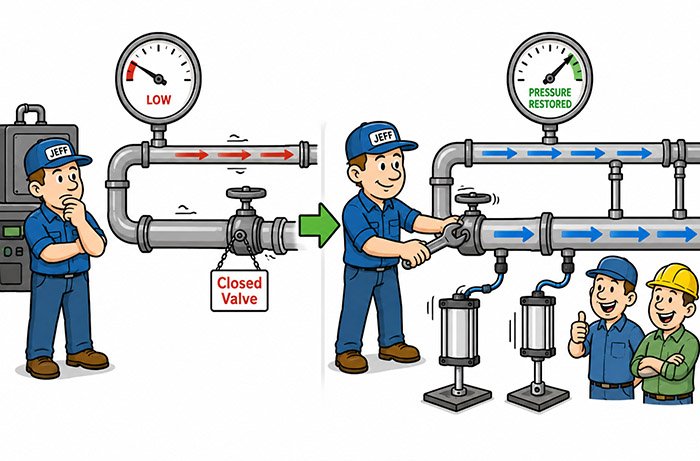
Jeff noticed that two lines ran parallel through the mechanical room. The original line was relatively small and had served the area for many years. A much larger header was later installed beside it to handle future expansion and reduce pressure loss. The larger line ran for nearly 100 ft before reconnecting with the distribution system downstream and should have provided a low-resistance path for most of the airflow.
Then Jeff spotted the problem. The isolation valve feeding the larger pipe was fully closed. Someone had probably shut the valve during construction or maintenance and never reopened it. As a result, the entire airflow to the assembly area was being forced through the original undersized pipe while the larger header sat unused.
After confirming that the larger piping section was complete, connected properly, and safe to place in service, Jeff slowly opened the isolation valve. The effect was almost immediate. Airflow divided between the two piping paths instead of being squeezed through the smaller line, and pressure at the assembly area began to rise.
Operators noticed the improvement before Jeff had finished putting away his tools. Pneumatic cylinders completed their strokes more smoothly, air tools regained their power, and production returned to normal. The plant also discovered that it no longer needed to maintain an artificially high compressor discharge pressure to overcome the unnecessary loss.
Later that week, Jeff reviewed the incident with the maintenance team. They could easily have replaced perfectly good filter elements, increased system pressure, or started planning for another compressor, yet none of those actions would have corrected the real problem. The entire issue had been caused by a single closed valve that forced compressed air through an undersized section of piping.
Jeff now shares the lesson with every new technician on his team. When pressure falls across a compressed air system, something is restricting the flow, but the restriction is not always where people expect it to be. Before replacing equipment or increasing compressor pressure, follow the air, measure pressure at several locations, trace the piping, and verify that every intended flow path is open. Sometimes the biggest compressed air improvement comes from opening a valve rather than opening the maintenance budget.
Filed Under: Air Compressors, Air Preparation, Components, Compressed Air Technologies, Pneumatic Tips
