
See how major manufacturers are reinventing steering to ensure safe and reliable control as machines become more autonomous.
At CONEXPO earlier this year, I had an opportunity to hail a ride from a Zoox taxi, an autonomous vehicle that provided rides to very specific destinations. That’s what really stood out to me as we cruised from the Zoox station at Resorts World to the Luxor — it was a set, pre-programmed route. We needed to walk about 20 minutes just to get to Resorts World to catch a ride in the carriage-type vehicle and we were lucky we were staying at Luxor, because it would only stop at a handful of pre-set locations.
This is where current autonomous machines excel, and why agriculture and mining machines are ideal applications for technology that can be programmed to run the same route repeatedly. And this is why steering showed up repeatedly as a focal point for automation and autonomy. Steer-by-wire is no longer just a control option; it is being positioned as the key interface between hydraulic power, electronic controls, and higher-level automation.
Rethinking safety and enabling automation
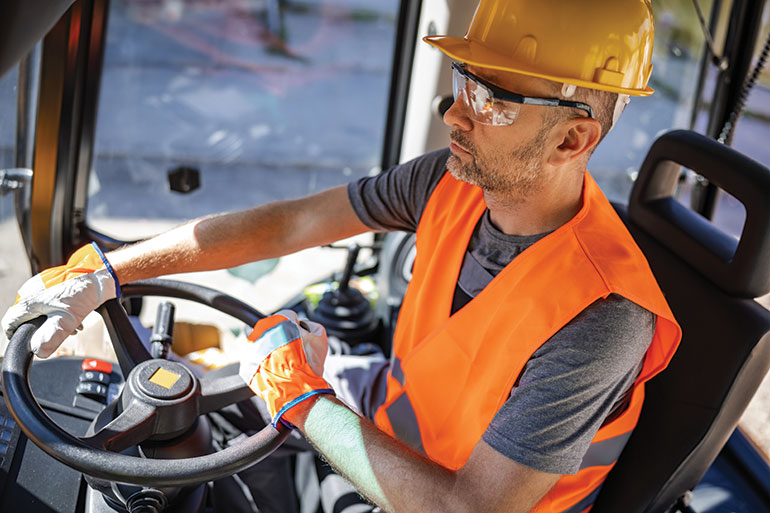
As we’ve written about previously, Husco positions its GenSteer system as a fundamental shift in how steering safety is approached on mobile machines. Traditional “road-safe” steer-by-wire systems typically retain a physical link — mechanical or hydraulic — between the operator and the steering axle. While familiar and commonplace, that linkage introduces complexity and additional failure points.
GenSteer takes a different approach by eliminating that dependency and instead uses operator-generated input as the basis for maintaining control, even in fault conditions. The goal is continuous steerability without relying on layered redundancy such as backup batteries or duplicate controllers. In this architecture, safety is not an added subsystem but an inherent characteristic of how steering force is generated and transmitted.
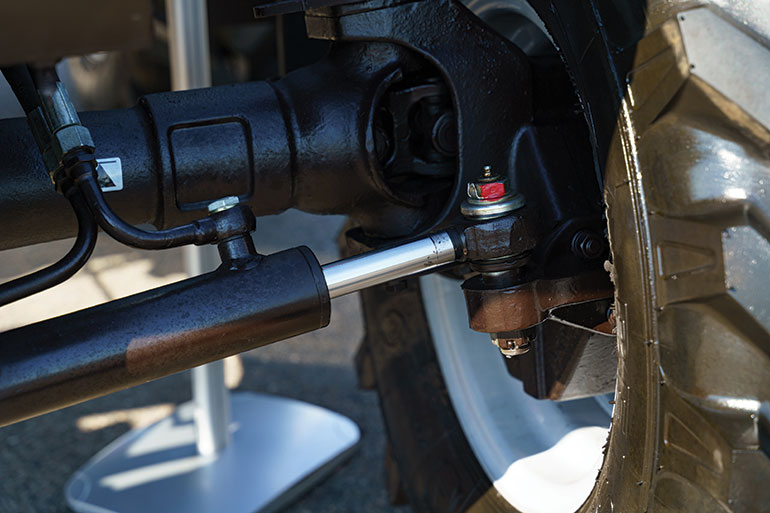
Equally important is how the system supports automation. By decoupling steering from mechanical constraints, GenSteer creates a platform that can be more easily integrated into automated machine architectures. The steering system effectively becomes “plug-in ready” for higher levels of control, allowing OEMs to layer in autonomous or semi-autonomous functions without redesigning the core steering hardware.
“Steer-by-wire has existed for decades. Aerospace is really what drove it. When you needed superhuman powers to handle driving a fighter jet or an Airbus 380, and you needed to be able to concentrate for hours at a time, you need automation,” said Ben Holter, Product Director, Mechatronics, HUSCO. “You need an ability to drive unstable machines. The solution for steer-by-wire has long been accepted in the aerospace industry. We were able to do things never thought possible. We can design a machine that’s inherently unstable and let the software help the operator make it better.”
This shift also enables software-defined steering behavior. Machines can dynamically adjust steering response based on the task — faster, more aggressive turning during repetitive loading cycles, for example, and slower, more precise control in confined spaces. In agricultural applications, that same flexibility allows high-speed steering in open fields and finer control when operating in tighter environments such as sheds or yards.
Valves, blocks and functional safety
Bosch Rexroth and HydraForce extend the steer-by-wire conversation through valve technology and integrated steering blocks designed for both automated and hybrid control modes.
Direct-acting valves play a key role in this transition. Compared to pilot-operated designs, they respond faster and more predictably, bringing an advantage when steering inputs are generated by software rather than a human operator. They also can handle larger amounts of flow, said Ross Johannes, Application Tech Services Team Leader, HydraForce.
“With the direct operator, you have a much faster valve than you would have with a pilot operated valve. With automated functions like steering, the direct acting can provide some advantages there,” Johannes said. “Computers controlling steering can change direction very fast. This valve gives you a better ability to keep up with that.”
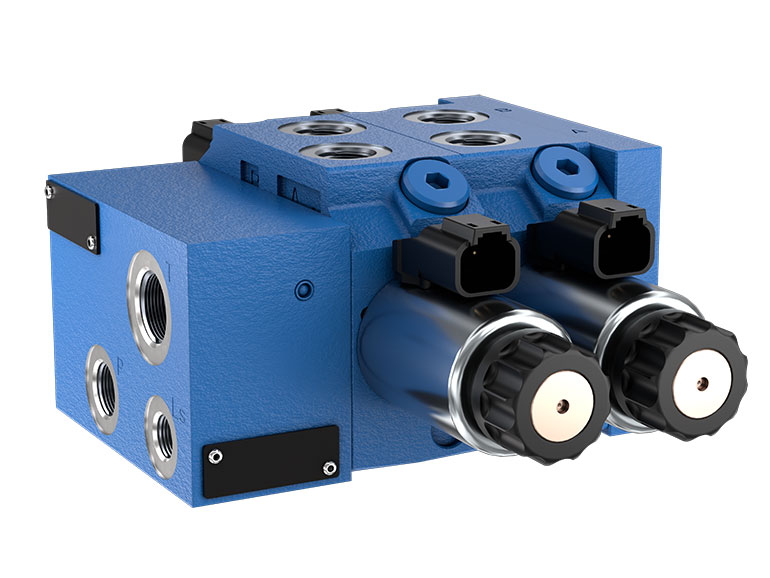
Pre-compensated valve designs further align with steering requirements, particularly in auto-steer and guidance applications where flow demands and response times must remain consistent. In these scenarios, traditional pilot-operated valves can struggle to keep up with rapid switching, while direct-acting solutions provide more stable performance.
At the system level, integrated steering blocks demonstrate how steer-by-wire can coexist with conventional architectures. These assemblies support parallel steering paths versus pure steer-by-wire, Ross said. For example, on an ag vehicle, you can steer with the wheel but may need to put your machine into auto guidance when row harvesting. “You have two steering axes, but this valve with the sensor would essentially block off the electronic steering circuit and verify that it’s blocked off. It can be dangerous if you ever have a contamination issue and your electronic steering valve is stuck open or broken for some other reason. You could end up with uncommanded movement or going the wrong way,” Ross said. “What this valve enables us to do is to shut off the electronic steering circuit, and then provide feedback on the valve to verify that it is closed. Having these types of sensors on cartridge valves really allows us to be put that system diagnostics in any circuit that we want.”
Hydac offers a similar concept, said Christopher Kolbe, Senior Vice President of Sales and Marketing at HYDAC Technology Corp. He highlighted a hydraulic valve that is driven electrically with an electric motor. “You have a sensor that tells you exactly where it is. From a functional safety standpoint, it knows exactly where it is, and from an accuracy standpoint, there’s zero hysteresis,” he said. “If the engine’s off, I can still operate this. If, some reason you must lower something, you can still actuate it without any hydraulic power.”
Control architecture and software integration
Steering does not evolve in isolation. At Rexroth, it is part of a larger shift toward software-defined machine control built on electronic joysticks, sensors and electronically controlled pumps.
The emphasis is on “control authority” — the ability to measure, command and consistently return a machine to a desired state. That capability underpins a growing range of operator-assist features, from automated digging cycles to guided machine movements.
“We’re setting the foundation stones for next generation technology, which is really all about the software. And then integrating all solutions, such as hydrostatic drives, motors and controls,” said Terry Hershberger, Mobile Hydraulics Technology Leader for Bosch Rexroth. “We’ve always talked about drive and control. Today it’s even extended beyond drive and control, because it’s software and the ability to measure, monitor and see.”
Hershberger noted that Rexroth’s software packages are designed to take a specific application, and especially ones with semi-automation, and make it simpler to use. For example, an excavator operator can make perfect lines due to the kinematics and software and hardware packages that ensure higher efficiency, lower engine speed, and higher control authority. Rexroth orients its solutions to the specific needs of the specific application.
“We’re providing the hardware and software, so we are involved with every aspect of the operation of that machine,” Hershberger said.
Building the foundation for autonomy
Across the industry, suppliers emphasize that hydraulics remain central even as machines become more autonomous. Hydraulic systems continue to provide the force and motion, while electronics and software define how that power is applied.
Garrett Bialosky, Global Mobile Systems, Industry Market Manager at Parker Hannifin, noted that Parker sees the growing role of closed-loop control, where pressure and flow data are continuously monitored to maintain safe and efficient operation. These same feedback systems support automated steering and broader machine functions, enabling everything from user-assist features to higher levels of autonomy.
“Different customers are looking to get the most out of machine, with autonomous control and safety control,” Bialosky said. “You’re always going to need those hydraulics, which Parker has, because that creates all your force and movement. But you want to start capturing through electronics, how everything’s performing, the pressures, the loads. There you take it into your controllers, and you use closed-loop control. You keep things in safe operation, autonomous control.”
Bialosky pointed to Parker’s TFD tactile feedback device as an entry into steer-by-wire paired with functional safety control. The armrest joystick allows you to feel different types of haptic feedback. He said that operators still like the hydraulic feel, so this provides electronic feedback that feels more like a natural hydraulic joystick. It also allows automatic return to center, where it pushes the wheels back inline.
Danfoss added that many manufacturers expect a complete system, with an electric motor that partners with hydraulic systems. This is why eSolutions are so important to Danfoss, said Joe Budden, eHydraulics Portfolio Manager at Danfoss Editron. This transition to electrohydraulic systems is now focused on automation and operator-assist capabilities.
Software development is becoming a key differentiator in this phase, with increasing use of advanced tools like Danfoss’ Plus+1 software product, to accelerate development cycles. At the same time, electrification efforts, such as electric pumps and traction systems, are being designed with integrated control architectures in mind. Steering, in this context, is expected to function as part of a unified, software-ready platform rather than a standalone subsystem.
“If our customers want to come to us and say, we just want to buy a pump from you, we’re happy to sell them a pump. But putting them together with a little bit of software, you’re gaining additional controllability, additional efficiency, and getting additional productivity out of the machine by doing it,” Budden said.
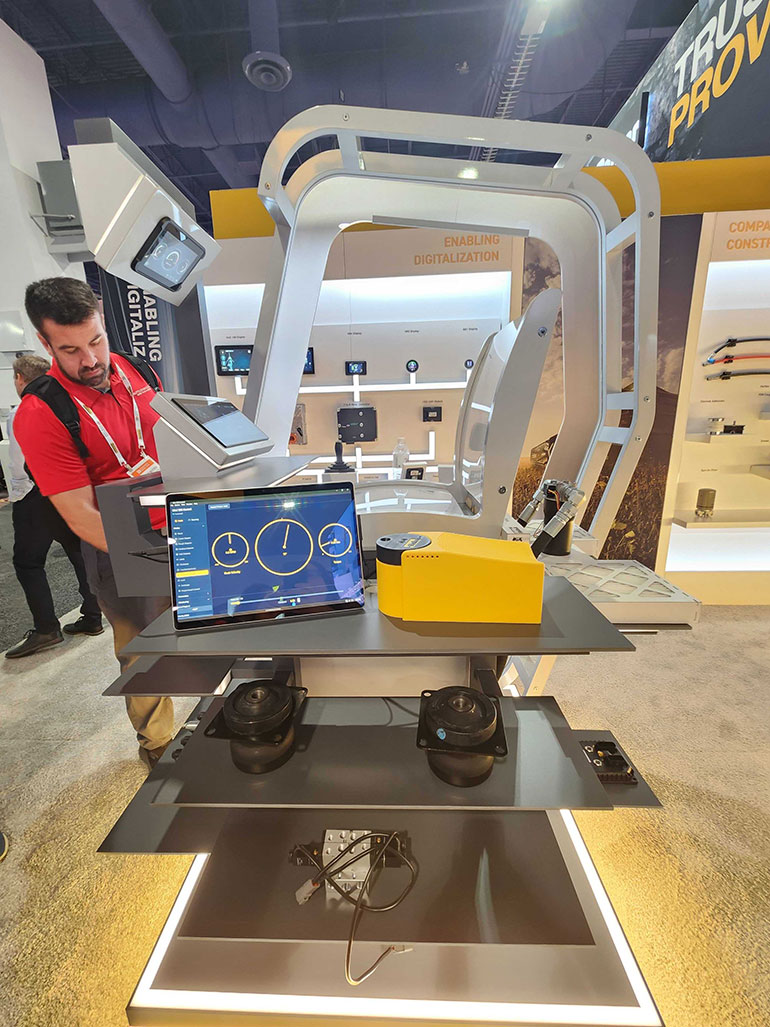
Danfoss showed where its current and newly released technologies can be used on an excavator model in hydraulics, e-hydraulics, electrification, digitalization, autonomy, and software through the subsystems common to construction machinery: propel, steer, work, and control. For steering, however, they offered a demonstration of a new electric steering unit which will be launched later this year. It ties directly to the steering wheel and can also connect to Danfoss’ electrohydraulic steering unit down below. The machine can be driven via steering wheel or joystick, and features easily changeable settings from light to heavy load for operator comfort and experience.
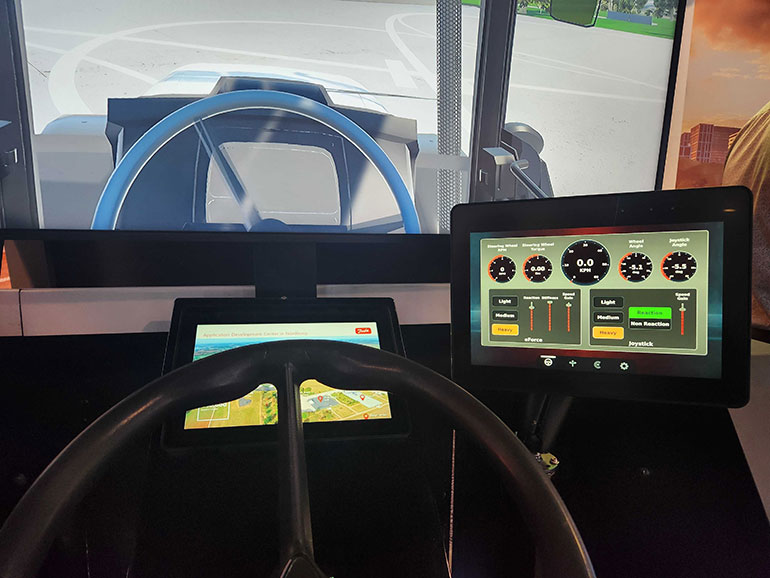
“Operator, comfort and feeling throughout the day is really important. We need to ask, what is the machine that we are working with? How do we give that best feel to the customer? That’s one of the key that’s driving our innovation in the steering units today,” said Ricky Anderson, Steering Sales Manager -Americas at Danfoss Power Solutions. “And we do the same thing with our standard steering units. We try to optimize the best feel for that type of machine. With both electrohydraulic and hydraulic, we always want to continue moving those all forward.”
Hydac’s Kolbe agreed about the need for holistic system development. “When you’re talking about user assisted functionality and autonomy, one of the key elements is steer-by-wire or brake-by-wire. The problem is, is if you buy the hydraulic hardware from somebody, the electrical hardware from somebody, and the sensor and controller, you then must certify all those parts together. What we do is we have controllers, sensors and a valve system that’s all functional safety rated for that,” Kolbe said. “We’re able to do joystick steer, steer-by-wire, and brake-by-wire, which enables our customers then to go to remote control, autonomy or user assist function.”
Filed Under: EV Engineering, Industry News, Mobile Hydraulic Tips, Trending
