
Contributed by Gleb Tsipursky, PhD, is a behavioral scientist and CEO of Disaster Avoidance Experts
A technician opens an AI assistant, enters a fault code and receives a likely cause with a suggested repair sequence. The explanation sounds convincing. Before anyone reaches for a tool, the supervisor asks one question: What evidence would prove the diagnosis wrong?
That question deserves a place in technician training. In February, Fluid Power World described an AI technician assistant that combines telemetry, fault codes, manuals and repair history to prioritize likely causes and guide repairs. Such systems can help technicians find relevant information. They can also let inexperienced employees reach the next step without learning why it is justified.
Mary Gannon’s argument for keeping people central to fluid power raises a practical question for shops and OEM service teams: How do we use AI to develop technicians’ judgment, rather than borrow it temporarily? My recommendation is a short training routine I call the fault-hypothesis exercise.
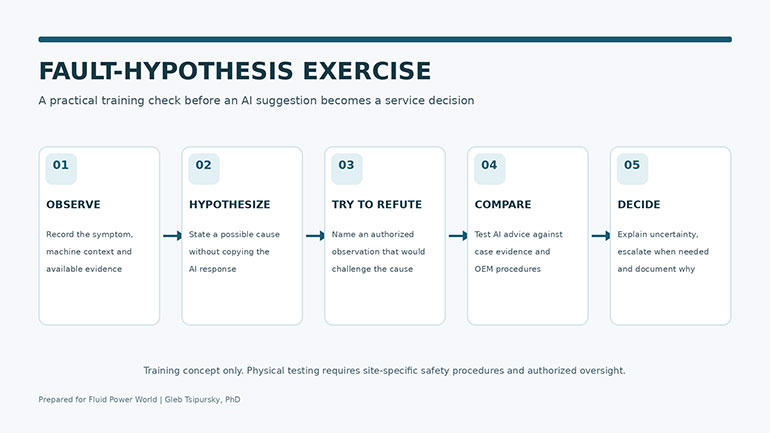
Require a hypothesis before the recommendation becomes an order
Start with a real but closed service case that a qualified supervisor has checked against the equipment documentation. Show the junior technician the symptoms, machine configuration and permitted observations. Ask for a one-sentence hypothesis before revealing the AI recommendation, where the workflow allows. If the AI result is already visible, have the technician explain the cause independently instead of copying the model’s wording.
Then ask what evidence could challenge that diagnosis: Which reading, inspection result or documented condition would make this explanation less likely? It must be available through an approved procedure and not simply repeat the AI’s own conclusion. Repeating the model’s confidence score or asking it whether it agrees with itself accomplishes little.
Two rules keep the exercise useful. A trainee should be allowed to record “insufficient evidence” when several explanations fit the observations, provided the next step is to escalate the issue appropriately. And supervisors should select cases in which the available evidence can distinguish competing hypotheses. An exercise whose answer depends on undisclosed experience teaches guessing rather than diagnosis.
This mirrors skills the International Fluid Power Society expects of an industrial hydraulic mechanic: troubleshooting with schematics, measuring instruments and diagnostic equipment. Its technician certification also assesses documented testing and troubleshooting, including a hands-on examination. AI can organize knowledge, but the trainee still needs to interpret evidence from a particular machine.
Let an ordinary fault challenge the answer
Consider a case close to Ron Marshall described in Fluid Power World: operators complained of weak pneumatic performance, and a clogged filter looked plausible. Yet the differential-pressure readings across the filters did not support that diagnosis. Additional checks narrowed the loss to another part of the air-distribution system.
For a classroom version, imagine the AI recommends changing the filter. The trainee writes the hypothesis and identifies the filter differential as evidence that could challenge it. The supervisor supplies the case’s already-recorded readings. The trainee then explains why those readings weaken the proposed diagnosis and what existing documentation or authorized observation should be considered next. Nobody needs to perform a hazardous live test to learn the reasoning.
A hydraulic case can use the same logic without pretending that all faults have a single signature. Fluid Power World’s discussion of slow hydraulic-cylinder movement illustrates how several possible flow paths can produce similar symptoms. In training, the question is which observation distinguishes one explanation from another on this circuit, under these conditions. A component name supplied by an AI assistant is the beginning of an investigation.
Put safety and escalation outside the AI’s discretion
The exercise belongs inside the employer’s approved maintenance program. Under OSHA’s hazardous-energy control standard, servicing work covered by the rule requires established energy-control procedures, training and verification of isolation. OSHA has specifically explained that shutting down a hydraulic pump may leave hazardous stored pressure. An AI suggestion never authorizes a trainee to crack a line, defeat an interlock, run an unsafe pressure test or depart from OEM instructions.
Use prepared case records for initial practice. For a live job, the qualified person in charge decides whether an observation is safe, who is authorized to obtain it and when to escalate. The technician’s record should distinguish what was actually measured, what the AI inferred and what remains unknown. If the data or machine identity does not match the recommendation, the technician should pause and seek qualified review.
Score the reasoning, then test the training
A useful worksheet fits on a small card: symptom and operating context; initial hypothesis; observation that could refute it; AI recommendation and its source; final decision, uncertainty and escalation. The supervisor can review it during an ordinary service debrief, asking which fact changed the trainee’s mind. Avoid awarding points for agreeing with the model or for guessing the final replacement part.
That approach fits the National Institute of Standards and Technology’s guidance on defining human oversight and operator proficiency. Its value, however, should be tested rather than assumed. Have a small group of trainees practice with vetted historical cases. Later, give them unfamiliar cases and score whether they identify a plausible alternative, choose evidence that can distinguish between possible causes, respect safety boundaries and escalate appropriately. Compare their performance with their previous training results or another appropriate group, while separately tracking actual repair outcomes.
Have reviewers score the trainee’s reasoning before revealing how the case was ultimately resolved, reducing the temptation to reward hindsight. Include cases in which the assistant uses the wrong machine configuration, offers a poorly supported conclusion or lacks needed data. Stopping when an authorized test cannot be performed should count as correct judgment, rather than a failure to finish.
Measure time to a defensible decision alongside first-time fixes and unnecessary part replacements. Faster completion is worthwhile only when technicians retain the ability to explain and challenge their decisions. The growing availability of connected machine data and remote diagnostics makes that distinction more consequential, because information can reach the technician before an experienced colleague does.
A well-designed assistant should help a technician ask better questions. The fault-hypothesis exercise gives supervisors a way to see whether that is happening, one documented decision at a time.
Gleb Tsipursky, PhD, is a behavioral scientist and CEO of Disaster Avoidance Experts, and author of The Psychology of AI Adoption at Work: From Resistance to Results (Georgetown University Press, 2026), disasteravoidanceexperts.com/aibook
Filed Under: AI Engineering Collective, News, Trending
